FinOps for AI Agents: Who Spent All the Tokens?
Conference Context
- Date/time: 2026-07-01 · 11:10am-11:30am
- Track/room: AI Architects: AI Factories · Leadership 2
- Speaker(s): Tisha Chawla, Susheem Koul
- Session type/status: session · confirmed
- Track: AI Architects: AI Factories
- Room: Leadership 2
- Session type: session
- Status: confirmed
Session Description
When an autonomous agent finishes a task successfully but costs ten times more than it did the previous day, traditional application monitoring fails. A recursive tool loop that retries silently, an oversized context window that quietly expands, or an unflagged model upgrade can burn through an entire budget long before a human notices. The execution appears successful on functional dashboards, meaning the only clear signal of failure is the cloud invoice at the end of the month. As AI systems move into production, tokens have become a primary operational resource alongside CPU, memory, and storage, yet few teams manage them with equivalent systems rigor. Most architectures lack the granular visibility required to attribute token spend to specific users, agents, or workflows, and they lack mechanisms to terminate a runaway loop before it triggers a financial incident. This session treats token consumption as a first class systems problem, demonstrating how to make it observable, attributable, and enforceable across complex agent workflows. The presentation covers practical engineering patterns for instrumenting token usage at every model call and tool invocation, attributing costs down to specific users or business operations, surfacing expensive execution paths, and enforcing runtime budgets, quotas, and circuit breakers to halt runaway behavior in real time. Attendees will leave with a practical framework for governing agent spend deliberately, transforming tokens into a managed operational resource rather than a surprise line item on the cloud bill.
Media Evidence
Your Agent Failed in Prod. Good Luck Reproducing It. - Tisha Chawla & Susheem Koul, Microsoft (speaker-match related prior/adjacent AI Engineer video; captions: English auto-captions).
- Source video:
youtube-Lc8zRh9muoY - Slide deck: Dense Slides: Your Agent Failed in Prod. Good Luck Reproducing It. - Tisha Chawla & Susheem Koul, Microsoft — 5 visible slide image(s); 5 HTML recreation(s).
- Additional slide evidence: Slides: Your Agent Failed in Prod. Good Luck Reproducing It. - Tisha Chawla & Susheem Koul, Microsoft, Reconstructed Slides: Your Agent Failed in Prod. Good Luck Reproducing It. - Tisha Chawla & Susheem Koul, Microsoft
- Slide-derived themes for
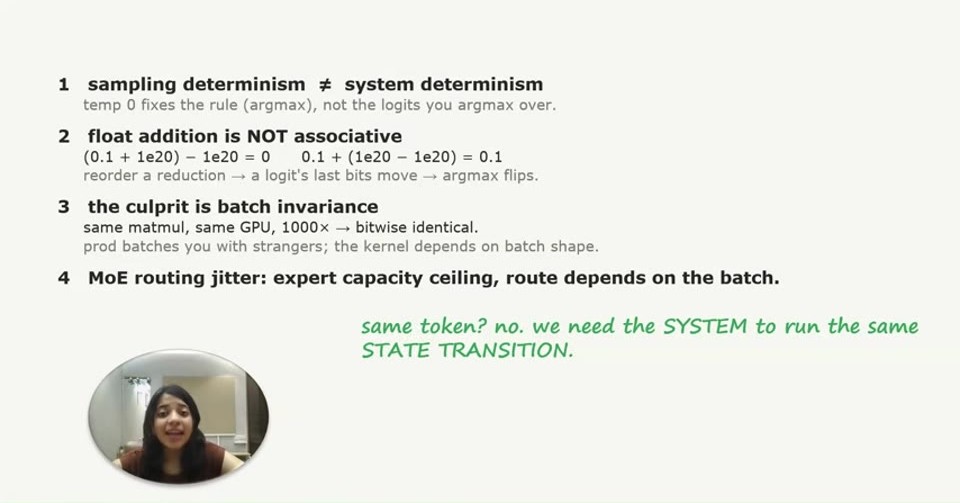
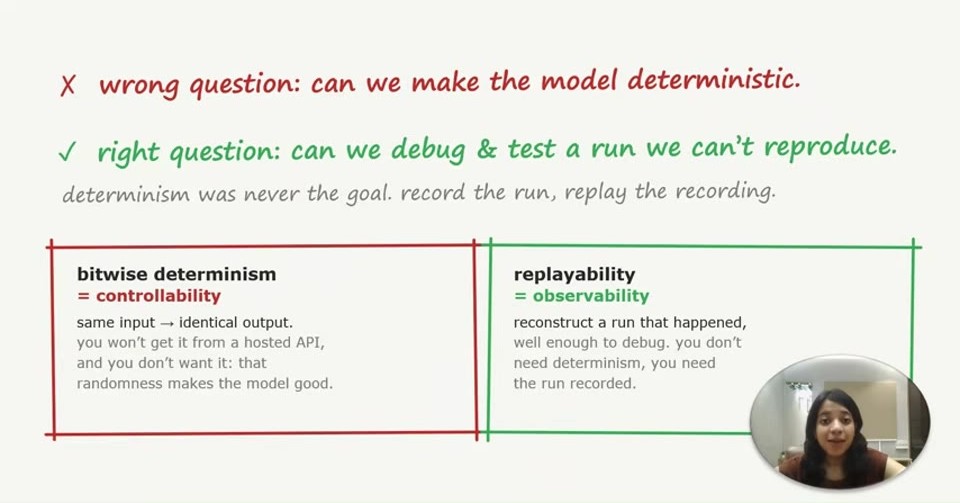
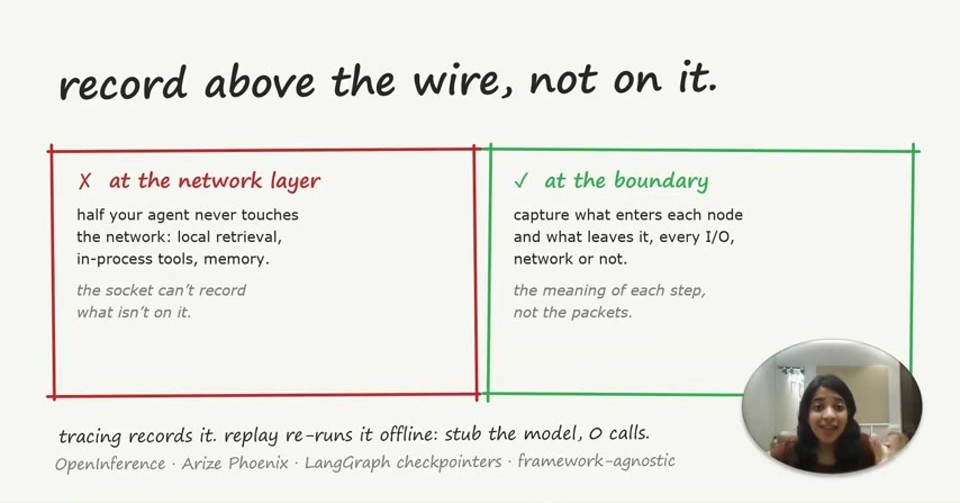
youtube-Lc8zRh9muoY: determinism, batch, system, depends, never, record, replay, network.
Evidence Graph
This evidence graph is generated from currently linked source material: official schedule text, related video pages, cached transcripts, visible slide text, dense/reconstructed slide pages, and AI slide-classification audits.
Media Signals
youtube-Lc8zRh9muoY— 9 slide-derived text signals- Slide-derived themes for
youtube-Lc8zRh9muoY: determinism, batch, system, depends, never, record, replay, network. - Evidence links for
youtube-Lc8zRh9muoY: youtube Lc8zRh9muoY, youtube Lc8zRh9muoY slides, youtube Lc8zRh9muoY dense slides, youtube Lc8zRh9muoY reconstructed slides
Agent Reading Notes
Use these signals to refine the synopsis, topic links, people/company context, and method notes. If a source is a related external video rather than an exact official recording, keep it framed as supporting evidence.
Transcript Status
Related video transcript availability: English auto-captions. Treat this as supporting context, not a recording of this exact scheduled session unless later confirmed. Not fetched yet.
People
Supporting Slides
- youtube Lc8zRh9muoY slides — extracted from the related public AI Engineer video.
Slide Evidence
- Slide-only cropped deck: youtube Lc8zRh9muoY dense slides (6 viable slide images).
- Related slide/OCR pages:
- youtube Lc8zRh9muoY dense slides
- youtube Lc8zRh9muoY reconstructed slides
- youtube Lc8zRh9muoY slides
- Slide-derived terms:
live,sell,boundary,place_order,tool,symbol,quantity,determinism,acme,dict,record,side,argmax,replay,output,place_order-1.jsonm,agent-1.jsonm,filled
Attendance Visibility
No high-confidence attendance icon signal is shown for this talk. The sampled video evidence was either low confidence, source-proxy-only, or did not expose a clear audience view.
Synthesis
Synthesized Breakdown
FinOps for AI Agents: Who Spent All the Tokens? ## Conference Context - Date/time: 2026-07-01 · 11:10am-11:30am - Track/room: AI Architects: AI Factories · Leadership 2 - Speaker(s): Tisha Chawla, Susheem Koul - Session type/status: session · confirmed - Track: AI Architects: AI Factories - Room: Leadership 2 - Session type: session - Status: confirmed ## Session Description When an autonomous agent finishes a task successfully but costs ten times more than it did the previous day, traditional application monitoring fails. A recursive tool loop that retries silently, an oversized context window that quietly expands, or an unflagged model upgrade can burn through an entire budget long before a human notices. The execution appears successful on functional dashboards, meaning the only clear signal of failure is the cloud invoice at the end of the month.
Speaker And Company Context
- Tisha Chawla — Software Engineer at Microsoft.
- Susheem Koul — Senior Software Engineer at Microsoft.
Topics Covered
Derived Links And Source Material
- youtube Lc8zRh9muoY — related YouTube source page.
- youtube Lc8zRh9muoY slides — slide evidence.
- youtube Lc8zRh9muoY reconstructed slides — slide evidence.
- youtube Lc8zRh9muoY dense slides — slide evidence.
Novel Concepts / Clever Methods
- No highlighted novel concept has been detected yet.
Evidence Boundary
This synthesis is based on the official schedule and linked source pages. It should be revisited when exact session recordings or transcript-backed secondary sources are available.