On-Device Agentic AI for the New York Times Games
Conference Context
- Date/time: 2026-07-01 · 2:50pm-3:10pm
- Track/room: Graphs · Track 5
- Speaker(s): Shafik Quoraishee, Joanne Song
- Session type/status: sponsor · confirmed
- Track: Graphs
- Room: Track 5
- Session type: sponsor
- Status: confirmed
Session Description
Traditional mobile game architectures rely on static state machines and fixed behavioral trees. Under this model, gameplay and accessibility are treated as rigid, separate systems. This results in blunt difficulty toggles, predictable character loops, and reactive features that fail to address a player's actual context. Constraint-Centric Agentic Simulation (CCAS) offers a theoretical shift. By modeling the game world as a continuous, multi-agent negotiation, accessibility and challenge become part of a single, fluid continuum. Using the JetBrains Koog framework on Android, this session explores the theory of running local agents on consumer mobile devices. We will discuss how principles of game theory, specifically dynamic negotiation and constraint satisfaction, can be used to build systems that reason over game states. Instead of executing pre-planned scripts, these agents dynamically alter their strategies. They negotiate environmental constraints to provide emergent challenges for high-skill players or organically smooth out cognitive and motor friction points for those requiring assistance. Running these theoretical models on edge hardware requires overcoming significant practical hurdles. We will break down the architecture needed to support this continuous adaptation without relying on cloud computation. We will cover how to manage memory footprints, compress state histories for rapid backtracking, and schedule local planning loops so they integrate flawlessly with the rendering engine.
Media Evidence
New York Times' Connections: A Case Study on NLP in Word Games — Shafik Quoraishee, NYT Games (speaker-match related prior/adjacent AI Engineer video; captions: English auto-captions).
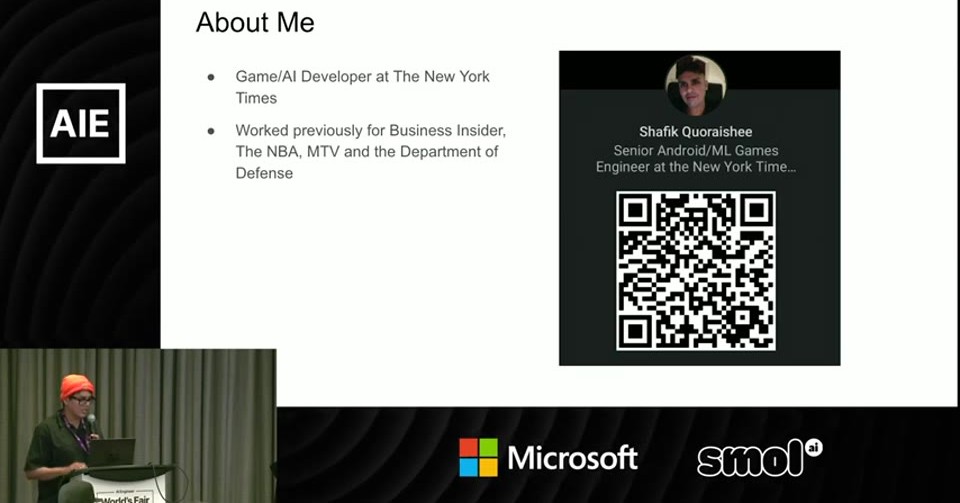
These are phone-photo slide captures from the Google Photos AIE Slides album. They are supporting slide evidence and do not override official schedule fields.
- google photos aie slides 9gWZzS1EpXM1C5eK6 nyt games connections slides - Google Photos Slides: On-Device Agentic AI for the New York Times Games (confidence: high).
- Source video:
youtube-P_uhFGH4J9Y - Slide deck: Dense Slides: New York Times' Connections: A Case Study on NLP in Word Games — Shafik Quoraishee, NYT Games — 2 visible slide image(s); 2 HTML recreation(s).
- Additional slide evidence: Slides: New York Times' Connections: A Case Study on NLP in Word Games — Shafik Quoraishee, NYT Games, Reconstructed Slides: New York Times' Connections: A Case Study on NLP in Word Games — Shafik Quoraishee, NYT Games
- Slide-derived themes for
youtube-P_uhFGH4J9Y: york, research, game, developer, times, worked, previously, business.
Evidence Graph
This evidence graph is generated from currently linked source material: official schedule text, related video pages, cached transcripts, visible slide text, dense/reconstructed slide pages, and AI slide-classification audits.
Media Signals
youtube-P_uhFGH4J9Y— 4 slide-derived text signals- Slide-derived themes for
youtube-P_uhFGH4J9Y: york, research, game, developer, times, worked, previously, business. - Evidence links for
youtube-P_uhFGH4J9Y: youtube P_uhFGH4J9Y, youtube P_uhFGH4J9Y slides, youtube P_uhFGH4J9Y dense slides, youtube P_uhFGH4J9Y reconstructed slides
Agent Reading Notes
Use these signals to refine the synopsis, topic links, people/company context, and method notes. If a source is a related external video rather than an exact official recording, keep it framed as supporting evidence.
Transcript Status
Related video transcript availability: English auto-captions. Treat this as supporting context, not a recording of this exact scheduled session unless later confirmed. Not fetched yet.
People
Supporting Slides
- youtube P_uhFGH4J9Y slides — extracted from the related public AI Engineer video.
Slide Evidence
- Slide-only cropped deck: youtube P_uhFGH4J9Y dense slides (2 viable slide images).
- Related slide/OCR pages:
- youtube P_uhFGH4J9Y dense slides
- youtube P_uhFGH4J9Y reconstructed slides
- youtube P_uhFGH4J9Y slides
- Slide-derived terms:
york,times,microsoft,connections,semantic,research,game,reinforcement,score,awss,graphite,windsurf,mongobb,mdaily,augmentcode,workos,game/al,developer
Synthesis
Synthesized Breakdown
On-Device Agentic AI for the New York Times Games ## Conference Context - Date/time: 2026-07-01 · 2:50pm-3:10pm - Track/room: Graphs · Track 5 - Speaker(s): Shafik Quoraishee, Joanne Song - Session type/status: sponsor · confirmed - Track: Graphs - Room: Track 5 - Session type: sponsor - Status: confirmed ## Session Description Traditional mobile game architectures rely on static state machines and fixed behavioral trees. Under this model, gameplay and accessibility are treated as rigid, separate systems. This results in blunt difficulty toggles, predictable character loops, and reactive features that fail to address a player's actual context. Constraint-Centric Agentic Simulation (CCAS) offers a theoretical shift.
Speaker And Company Context
- Shafik Quoraishee — Staff Engineer at The New York Times.
- Joanne Song — role not listed at The New York Times Games.
Topics Covered
Derived Links And Source Material
- youtube P_uhFGH4J9Y — related YouTube source page.
- youtube P_uhFGH4J9Y slides — slide evidence.
- youtube P_uhFGH4J9Y reconstructed slides — slide evidence.
- youtube P_uhFGH4J9Y dense slides — slide evidence.
Novel Concepts / Clever Methods
- No highlighted novel concept has been detected yet.
Evidence Boundary
This synthesis is based on the official schedule and linked source pages. It should be revisited when exact session recordings or transcript-backed secondary sources are available.