How to generate mergeable code with a context engine
Conference Context
- Date/time: 2026-06-30 · 11:40am-12:00pm
- Track/room: track TBD · Expo Stage 2 NW
- Speaker(s): Peter Werry
- Session type/status: session · confirmed
- Track: track TBD
- Room: Expo Stage 2 NW
- Session type: session
- Status: confirmed
Session Description
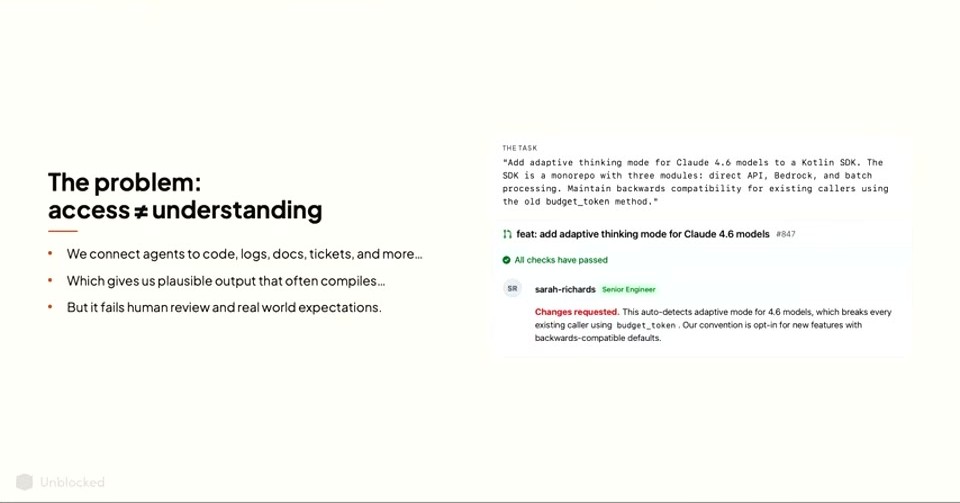
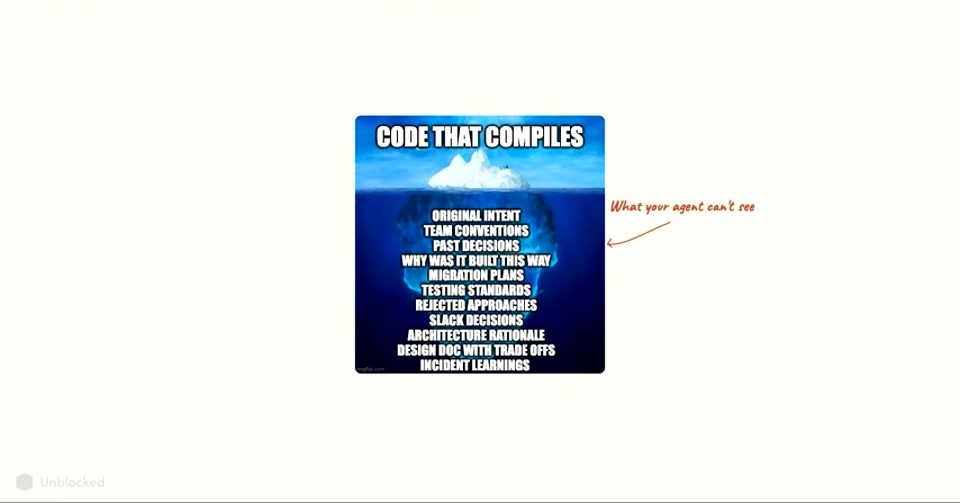
Your agents are fast, capable, and completely context-blind. They generate code that compiles but doesn't reflect how your system actually works. You're likely already seeing the impact: ballooning token costs, longer review cycles, and inconsistent outputs. More MCPs, rules, and bigger context windows give agents access to information, but not understanding. In this session, we dissect how teams pulling ahead use a context engine to give agents exactly what they need for the task at hand. Includes a short demo showing the workflows a context engine can augment.
Media Evidence
Mergeable by default: Building the context engine to save time and tokens — Peter Werry, Unblocked (speaker-match related prior/adjacent AI Engineer video; captions: English auto-captions).
- Source video:
youtube-5ID22ACI7IM - Slide deck: Dense Slides: Mergeable by default: Building the context engine to save time and tokens — Peter Werry, Unblocked — 4 visible slide image(s); 4 HTML recreation(s).
- Additional slide evidence: Slides: Mergeable by default: Building the context engine to save time and tokens — Peter Werry, Unblocked, Reconstructed Slides: Mergeable by default: Building the context engine to save time and tokens — Peter Werry, Unblocked
- Slide-derived themes for
youtube-5ID22ACI7IM: connect, code, logs, docs, tickets, gives, plausible, output.
Evidence Graph
This evidence graph is generated from currently linked source material: official schedule text, related video pages, cached transcripts, visible slide text, dense/reconstructed slide pages, and AI slide-classification audits.
Media Signals
youtube-5ID22ACI7IM— 4 slide-derived text signals- Slide-derived themes for
youtube-5ID22ACI7IM: connect, code, logs, docs, tickets, gives, plausible, output. - Evidence links for
youtube-5ID22ACI7IM: youtube 5ID22ACI7IM, youtube 5ID22ACI7IM slides, youtube 5ID22ACI7IM dense slides, youtube 5ID22ACI7IM reconstructed slides
Agent Reading Notes
Use these signals to refine the synopsis, topic links, people/company context, and method notes. If a source is a related external video rather than an exact official recording, keep it framed as supporting evidence.
Summary
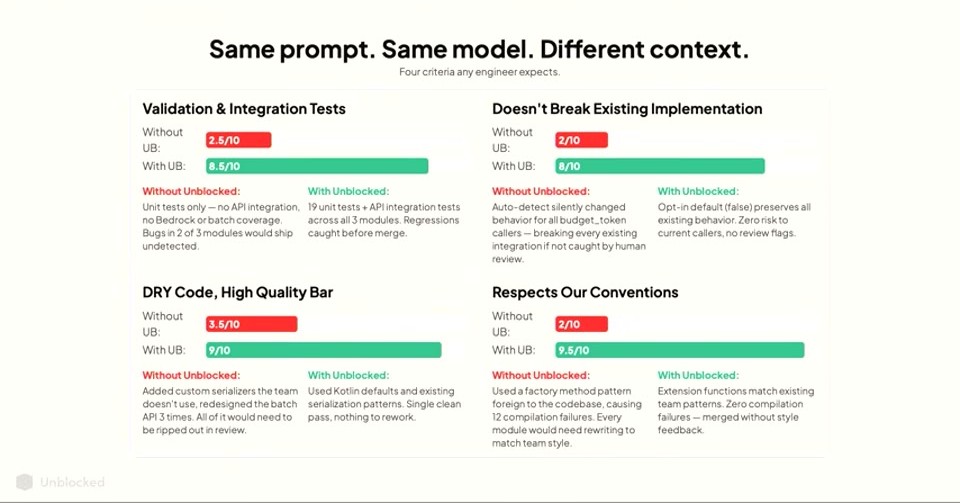
Peter Werry's session centers on a concrete failure mode for coding agents: they can produce compilable code while still missing the project-specific relationships, conventions, ownership boundaries, and review expectations that make code mergeable. The connected Unblocked video and extracted slides frame the answer as a context engine rather than a larger prompt, bigger context window, or pile of disconnected MCP tools. The core idea is to assemble task-specific engineering context from a relational understanding of the codebase and team workflow, so agents receive the information that matters for the current change instead of broad, expensive, and noisy context dumps.
The talk fits the World's Fair software-factories theme because it treats AI coding as a production system problem: reducing token waste, review churn, and inconsistent outputs by improving the inputs and workflow around agents. Werry's perspective comes from Unblocked's work on context engines for engineering teams, where the emphasis is on helping agents understand how a system actually works before they generate code. The related public AI Engineer video is supporting context rather than a confirmed recording of this exact session, but it points to the same thesis: mergeable-by-default code requires structured, workflow-aware context.
Transcript Status
Related video transcript availability: English auto-captions. Treat this as supporting context, not a recording of this exact scheduled session unless later confirmed. Not fetched yet.
People
Supporting Slides
- youtube 5ID22ACI7IM slides — extracted from the related public AI Engineer video.
Slide Evidence
- Slide-only cropped deck: youtube 5ID22ACI7IM dense slides (4 viable slide images).
- Related slide/OCR pages:
- youtube 5ID22ACI7IM dense slides
- youtube 5ID22ACI7IM reconstructed slides
- youtube 5ID22ACI7IM slides
- Slide-derived terms:
code,context,unblocked,tickets,review,tests,description,rere,planning,architecture,compiles,fails,undlocked,callers,quality,team,comp,improve
Synthesis
Synthesized Breakdown
How to generate mergeable code with a context engine ## Conference Context - Date/time: 2026-06-30 · 11:40am-12:00pm - Track/room: track TBD · Expo Stage 2 NW - Speaker(s): Peter Werry - Session type/status: session · confirmed - Track: track TBD - Room: Expo Stage 2 NW - Session type: session - Status: confirmed ## Session Description Your agents are fast, capable, and completely context-blind. They generate code that compiles but doesn't reflect how your system actually works. You're likely already seeing the impact: ballooning token costs, longer review cycles, and inconsistent outputs. More MCPs, rules, and bigger context windows give agents access to information, but not understanding.
Speaker And Company Context
- No speaker profile is attached in the official schedule data.
Topics Covered
Derived Links And Source Material
- youtube 5ID22ACI7IM — related YouTube source page.
- youtube 5ID22ACI7IM slides — slide evidence.
- youtube 5ID22ACI7IM reconstructed slides — slide evidence.
- youtube 5ID22ACI7IM dense slides — slide evidence.
Novel Concepts / Clever Methods
- No highlighted novel concept has been detected yet.
Evidence Boundary
This synthesis is based on the official schedule and linked source pages. It should be revisited when exact session recordings or transcript-backed secondary sources are available.