Voice Agents Can Just Do Things
Conference Context
- Date/time: 2026-06-29 · 11:40am-12:00pm
- Track/room: Voice & Realtime AI · Track 6
- Speaker(s): Charlie Guo
- Session type/status: session · confirmed
- Track: Voice & Realtime AI
- Room: Track 6
- Session type: session
- Status: confirmed
Session Description
Too many voice AI integrations still treat speech as fancier chat: audio in, audio out. But we're at a point where speech can be a control plane for software, and most developers are unaware that voice has become a capability overhang. Current realtime models can understand intent, call tools, speak while work is underway, recover from corrections, and decide what the user actually needs to hear. As a result, we're seeing three practical patterns emerge: voice-to-action, systems-to-voice, and voice-to-voice. We’ll show how each pattern changes the architecture, where Realtime 2’s reasoning and tool-calling matter, and why chained STT / LLM / TTS systems start to break down as the interaction patterns become richer.
Media Evidence
Analyzing 10,000 Sales Calls With AI In 2 Weeks — Charlie Guo (speaker-match related prior/adjacent AI Engineer video; captions: English auto-captions).
- youtube dvft0Gp9sEE transcript — full cached transcript markdown for the related YouTube source.
- Source video:
youtube-dvft0Gp9sEE - Slide deck: Dense Slides: Analyzing 10,000 Sales Calls With AI In 2 Weeks — Charlie Guo — 2 visible slide image(s); 2 HTML recreation(s).
- Additional slide evidence: Slides: Analyzing 10,000 Sales Calls With AI In 2 Weeks — Charlie Guo, Reconstructed Slides: Analyzing 10,000 Sales Calls With AI In 2 Weeks — Charlie Guo
- Slide-derived themes for
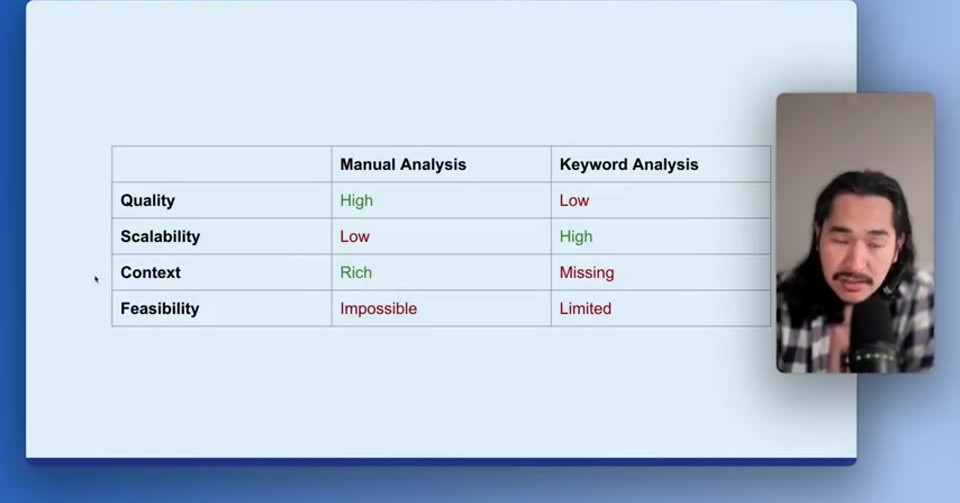
youtube-dvft0Gp9sEE: manual, analysis, keyword.

Evidence Graph
This evidence graph is generated from currently linked source material: official schedule text, related video pages, cached transcripts, visible slide text, dense/reconstructed slide pages, and AI slide-classification audits.
Media Signals
youtube-dvft0Gp9sEE— 1,508 transcript words; 1 slide-derived text signals- Transcript signals for
youtube-dvft0Gp9sEE: analysis, sales, transcript, models, calls, data, single, doing. - Slide-derived themes for
youtube-dvft0Gp9sEE: manual, analysis, keyword. - Evidence links for
youtube-dvft0Gp9sEE: youtube dvft0Gp9sEE, youtube dvft0Gp9sEE transcript, youtube dvft0Gp9sEE slides, youtube dvft0Gp9sEE dense slides, youtube dvft0Gp9sEE reconstructed slides
Agent Reading Notes
Use these signals to refine the synopsis, topic links, people/company context, and method notes. If a source is a related external video rather than an exact official recording, keep it framed as supporting evidence.
Transcript Status
Related video transcript availability: English auto-captions. Treat this as supporting context, not a recording of this exact scheduled session unless later confirmed. Cached at raw/sources/youtube-transcripts/dvft0Gp9sEE.txt (1,508 words).
People
Supporting Slides
- youtube dvft0Gp9sEE slides — extracted from the related public AI Engineer video.
Slide Evidence
- Slide-only cropped deck: youtube dvft0Gp9sEE dense slides (2 viable slide images).
- Related slide/OCR pages:
- youtube dvft0Gp9sEE dense slides
- youtube dvft0Gp9sEE reconstructed slides
- youtube dvft0Gp9sEE slides
- Slide-derived terms:
calls,shift,week,ideal,penve,soha,ieelall,ipest,potential,download,transcript,read,conversation,cane,arate,aceite,extract,insights
Attendance Visibility
No high-confidence attendance icon signal is shown for this talk. The sampled video evidence was either low confidence, source-proxy-only, or did not expose a clear audience view.
Synthesis
Synthesized Breakdown
I want to start with a question. How many sales calls can you listen to and take notes on in a single day? If you assume each call is 30 minutes and you work an 8 hour day with no lunch break, that gives you 16 calls. If you have absolutely zero work life balance and only stop to sleep for 8 hours a day, you might get to 32 calls.
Speaker And Company Context
- Charlie Guo — Developer Experience Engineer at OpenAI.
Topics Covered
Derived Links And Source Material
- youtube dvft0Gp9sEE transcript — transcript markdown; source cache
raw/sources/youtube-transcripts/dvft0Gp9sEE.txt(1,508 words). - youtube dvft0Gp9sEE — related YouTube source page.
- youtube dvft0Gp9sEE slides — slide evidence.
- youtube dvft0Gp9sEE reconstructed slides — slide evidence.
- youtube dvft0Gp9sEE dense slides — slide evidence.
Novel Concepts / Clever Methods
- Agent-Ready Accessibility — Designing for agents and designing for accessibility converge around explicit structure, reachable controls, and understandable state.
Evidence Boundary
This synthesis uses the official schedule plus cached video transcripts. Official AI Engineer World's Fair San Francisco 2026 livestreams and cut videos are primary event video sources for transcript/slide evidence; external, historical, or speaker-matched videos remain supporting context unless manually verified as exact official event recordings.