Slides: Using RL Agent to Detect and Remediate ETL Pipeline Failures - Anna Marie Benzon
Source Video
Using RL Agent to Detect and Remediate ETL Pipeline Failures - Anna Marie Benzon
Relationship To World's Fair 2026
These slides are extracted from a public AI Engineer YouTube video connected to World's Fair 2026. Speaker-matched clips are supporting context unless later confirmed as exact session recordings; official livestream recordings are day-level/event-level source material.
Related Scheduled Sessions
- No individual scheduled session mapping has been assigned yet; treat this as an event livestream deck.
Extracted Slides
- Recreated text/layout view: open HTML recreation
- AI slide classifier:
title_cardconfidence0.99 - Text source: agent_vision.
Slide text:
Using RL-based Agent to Detect and Remediate ETL Pipeline Failures
Presenter: Anna Marie Benzon
University of the Philippines, Diliman
github.com/ambenzon27/rl-etl-remediation-agent
- Recreated text/layout view: open HTML recreation
- AI slide classifier:
content_slideconfidence0.99 - Text source: advanced OCR
rapidocr-live/bright-screen/contrast. - OCR decision: ready — Dense multi-item slide with smaller body text and icon labels.
Slide text:
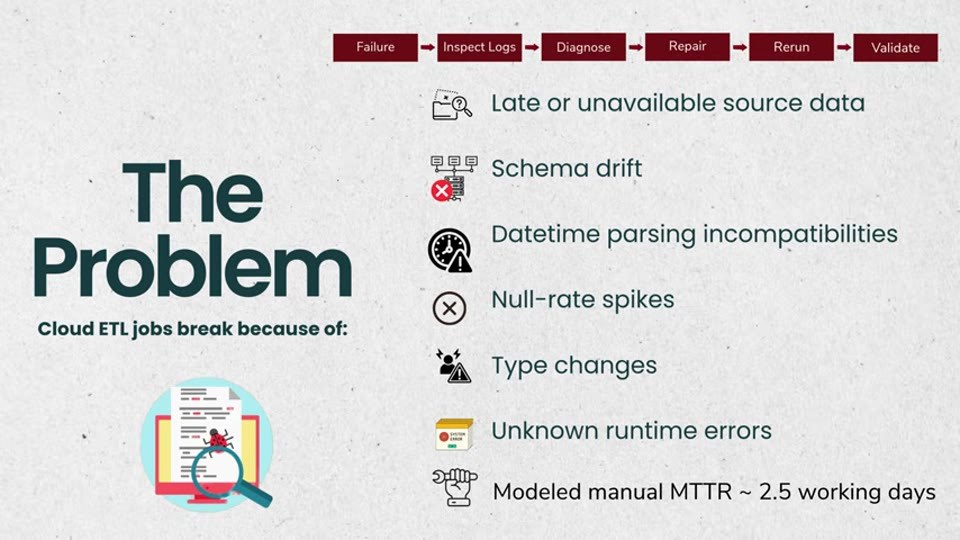
Failure Inspect Logs Diagnose Repair Rerun Validate
Late or unavailable source data
The 日日日 Schema drift
Problem Null-rate spikes Datetime parsing incompatibilities
Cloud ETL jobs break because of:
Type changes
Unknown runtime errors
Modeled manual MTTR ~ 2.5 working days
- Recreated text/layout view: open HTML recreation
- AI slide classifier:
content_slideconfidence0.98 - Text source: advanced OCR
rapidocr-live/bright-screen/opencv-adaptive. - OCR decision: ready — Architecture diagram and multiple text regions are better handled by OCR than direct transcription in triage.
Slide text:
Phate 1 Architecture -- Al Pipeline Heulth Agent
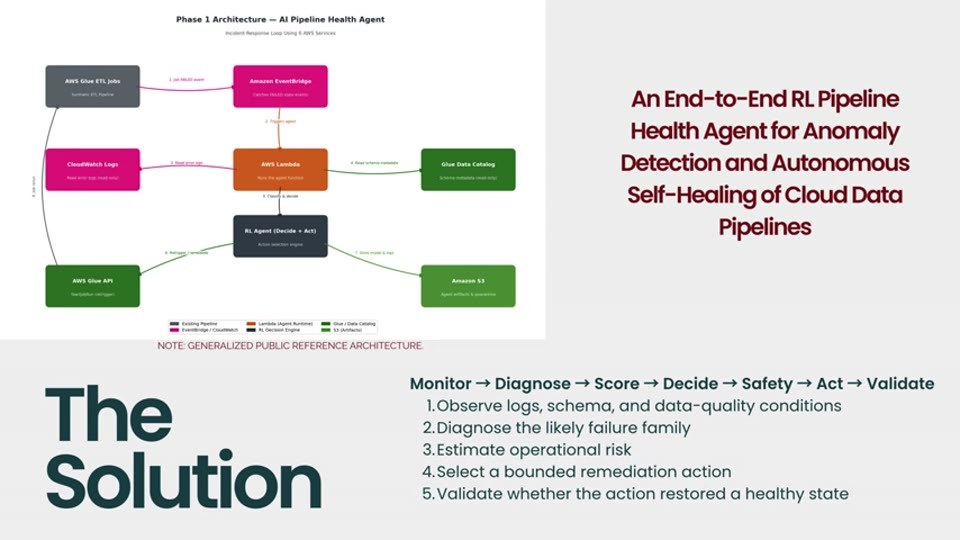
An End-to-End RL Pipeline
Health Agent for Anomaly
Detection and Autonomous
Self-Healing of Cloud Data
t tt+e+ + At Pipelines
t cttt th
: NOTE: GENERAUZED PUDUKC REFERENCE ARCHTTECTURE
Solution The Monitor → Diagnose → Score → Decide → Safety → Act Validate 2.Diagnose the likely failure family: 5.Validate whether the action restored a healthy state 3.Estimate operational risk 4.Select a bounded remediation action 1.observe logs, schema, and data-quality conditions
- Recreated text/layout view: open HTML recreation
- AI slide classifier:
content_slideconfidence0.97 - Text source: advanced OCR
rapidocr-live/bright-screen/opencv-adaptive. - OCR decision: ready — Diagram-heavy slide with small labels and policy text; OCR is better than direct extraction.
Slide text:
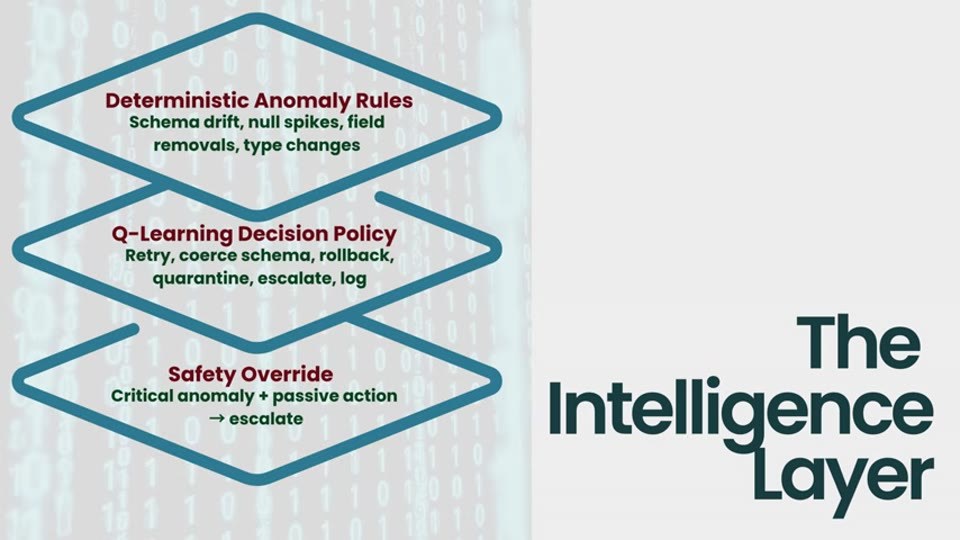
Deterministic Anomaly Rules Schema drift, null spikes, field
removals, type changes
Q-Learning Decision Policy Retry, coerce schema, rollback,. quarantine, escalate, log The
Critical anomaly.+ passive action Safety Override Intelligence
- escalate Layer
- Recreated text/layout view: open HTML recreation
- AI slide classifier:
content_slideconfidence0.99 - Text source: advanced OCR
rapidocr-live/bright-screen/contrast. - OCR decision: ready — Table layout with multiple small cells is OCR-suitable.
Slide text:
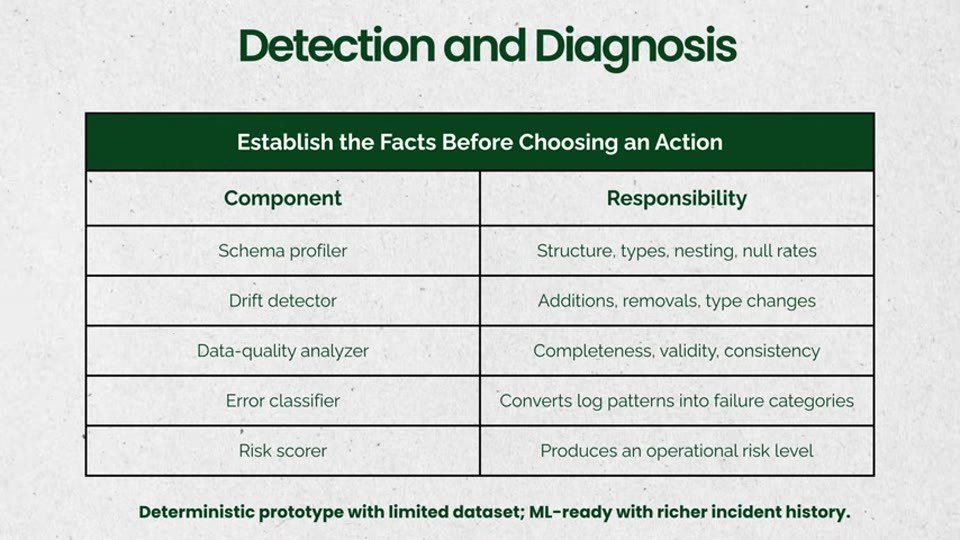
Detection and Diagnosis
Establish the Facts Before Choosing an Action
Component Responsibility
Schema profiler Structure, types, nesting. null rates
Drift detector Additions.removals.type changes
Data-quality analyzer Completeness, validity. consistency
Error classifier Converts log patterns into failure categories
Risk scorer Produces an operational risk level
Deterministic prototype with limited dataset; ML-ready with richer incident history.
- Recreated text/layout view: open HTML recreation
- AI slide classifier:
content_slideconfidence0.98 - Text source: advanced OCR
rapidocr-live/bright-screen/opencv-adaptive. - OCR decision: ready — Two-column state/action slide with small text and a footnote is OCR-suitable.
Slide text:
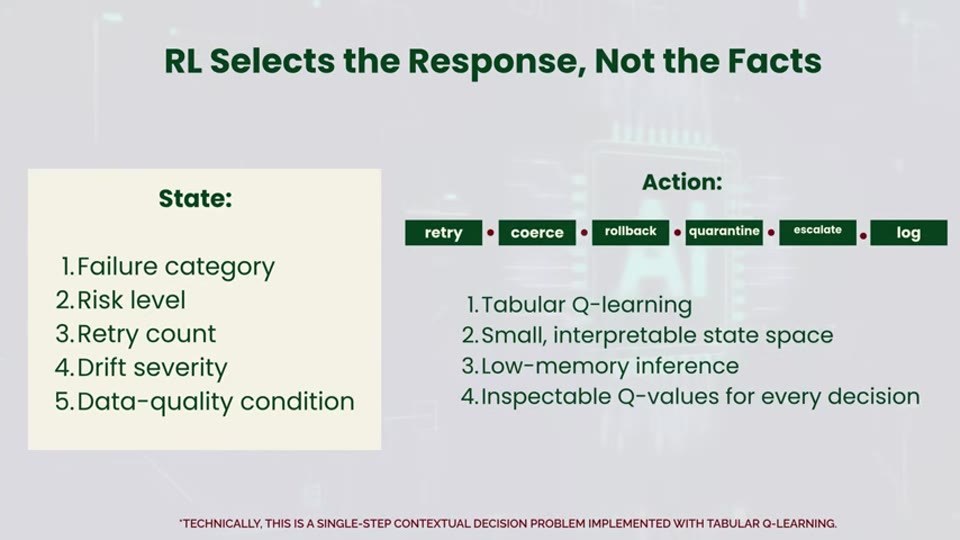
RL Selects the Response, Not the Facts
State: Action:.
retry [coerce] rollback quarantine oscalato [log]
1.Failure category
4.Drift severity 3.Retry count 2.Risk level 2.Small, interpretable statespace: 3.Low-memory.inference: 1. Tabular Q-learning
5.Data-quality condition 4.Inspectable Q-values for every decision
TeChNICALlY, ThIS IS a SInGLE-StEp CONTexTUAL DECISIoN prOBLem IMPlEmENTeD WiTH TaBULaR Q-LeaRnInG.:
-:-
- Recreated text/layout view: open HTML recreation
- AI slide classifier:
content_slideconfidence0.99 - Text source: agent_vision.
Slide text:
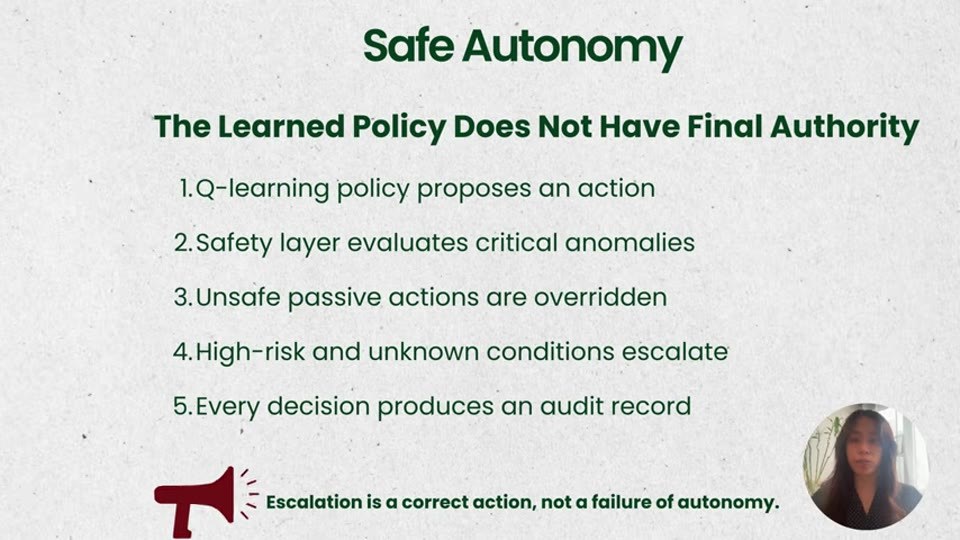
Safe Autonomy
The Learned Policy Does Not Have Final Authority
1. Q-learning policy proposes an action
2. Safety layer evaluates critical anomalies
3. Unsafe passive actions are overridden
4. High-risk and unknown conditions escalate
5. Every decision produces an audit record
Escalation is a correct action, not a failure of autonomy.
- Recreated text/layout view: open HTML recreation
- AI slide classifier:
content_slideconfidence0.99 - Text source: advanced OCR
rapidocr-live/bright-screen/opencv-adaptive. - OCR decision: ready — Dense code screenshot and multi-column content are better suited to OCR than direct transcription.
Slide text:
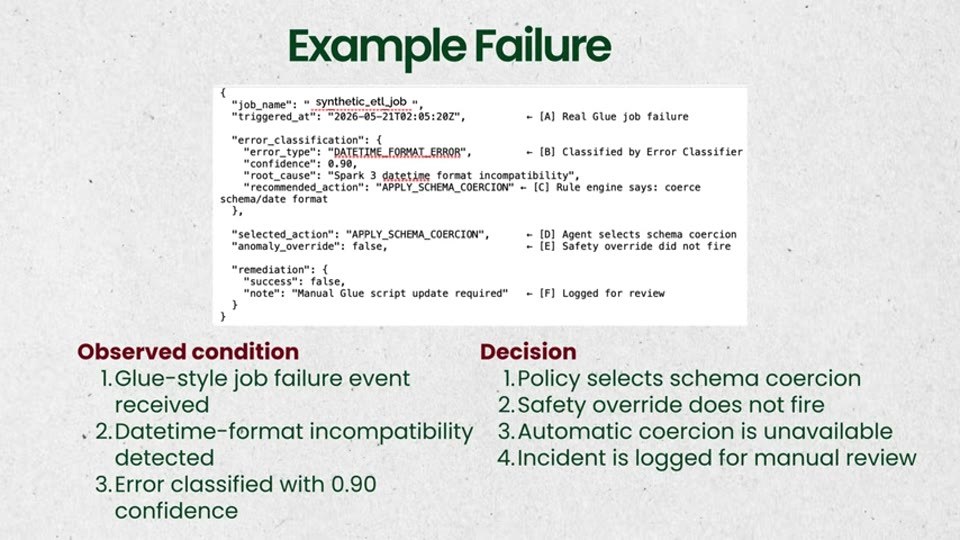
Example Failure
ntriggered_at: "2026-05-21te2:05:20z, "job_name": " Synthotic_etl Job ", - [A] Real Gtue job failure
"error_classification": { "error_tyPe": "PAIeTIME_FOfRAL ERROR". "confidence": o.90, - (B] classified by Error Classifle
scheaa/date foreat y. "recoamended_action": "APPLY_SCHEHA_COERCIoN" - [C] Rule engine says: coerce
"anonaly_override": fatse, - [E] Safety override did not fire + [o] Agent selects scheas coerclon
"reaedlation": { "note": -Hanual Gtue script update required" - [F] Loggcd for review "success": falsc,
Observed condition 1.Glue-style job fallure event Decision? 1.Policy selects schema coercion
received 2.safety override does not fire
2:Datetime-format incompatibility detected 3.Automatic coercion.is unavailable 4.lncident is logged for manual reviev
3.Error classified with 0.90
confidence
- Recreated text/layout view: open HTML recreation
- AI slide classifier:
content_slideconfidence0.99 - Text source: advanced OCR
rapidocr-live/bright-screen/opencv-adaptive. - OCR decision: ready — Small body text and embedded screenshot are better handled by OCR.
Slide text:
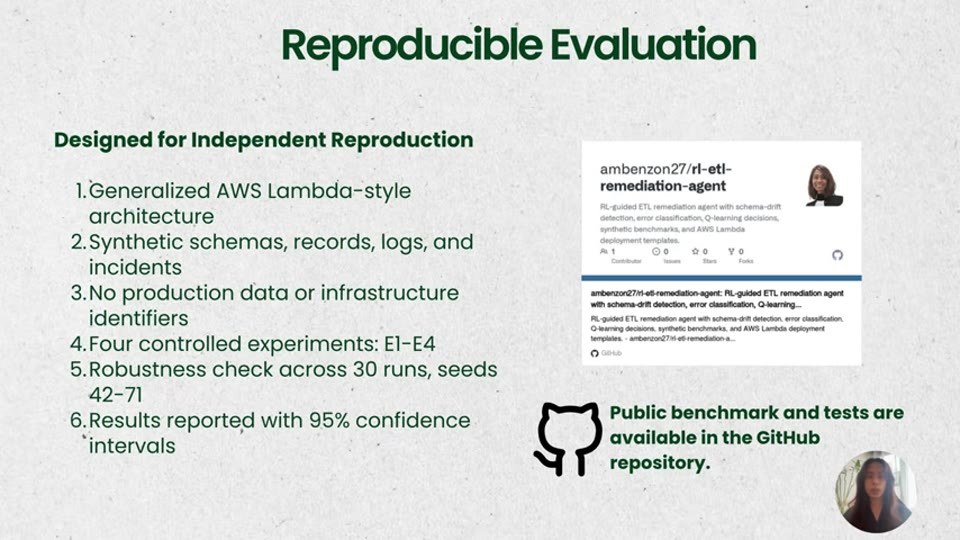
ReproducibleEvaluation
Designed for Independent Reproductior
1.Generalized AWs Lambda-style remediation-agent ambenzon27/rl-etl-
2.synthetic schemas, records, logs, and incidents architecture PLitLided ETL rerptataon L(ert ia tchtra -drn tvhtle brchmMi, ard Ais Llnbdh deyitor, enar cintilcenor, Qremrlng dtctTenr Yo
5.Robustness check across 30 runs, seeds 4.Four controlled experiments: El-E4 3.No production data or infrastructure identifiers: GTEo AL guita E?l Ttltdttan tgtl 1r TaTtai tttatr, tt atia Dulewto uoa.uwp oie 'uayphtp upio
6.Results reported with 95% confidence intervals 42-71 available in the GitHub Public benchmark and tests are
repository
- Recreated text/layout view: open HTML recreation
- AI slide classifier:
content_slideconfidence0.99 - Text source: advanced OCR
rapidocr-live/bright-screen/opencv-adaptive. - OCR decision: ready — Chart labels and benchmark metrics are small and OCR-suitable.
Slide text:
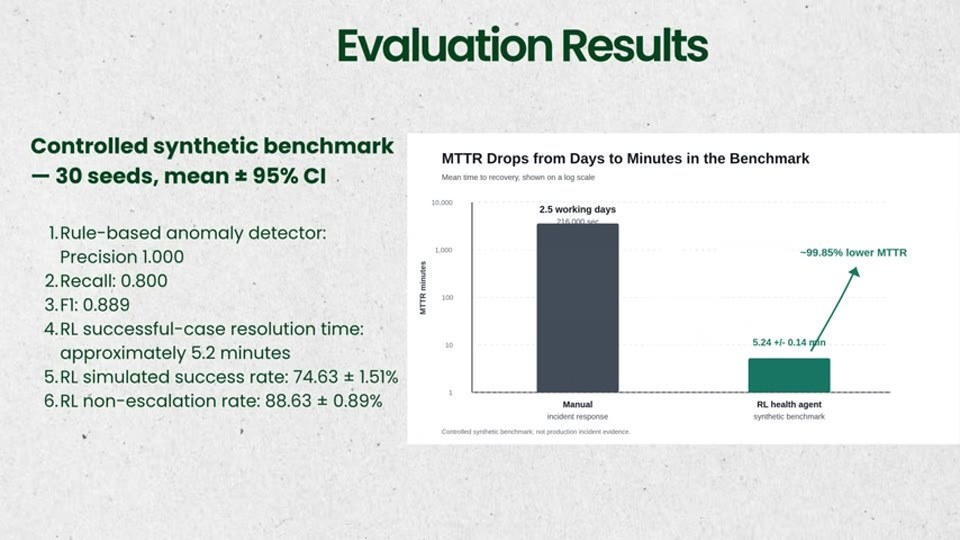
Evaluation Results
Controlled synthetic benchmark 30 seeds, mean ± 95% cl Htean iie to itcdiey, shotn on a log scale MTTR Drops from Days to Minutes in the Benchmark
1.Rule-based anomaly detector 10.000 2.5 working days
2.Recall: 0.800 Precision' 1.000 Loco -99.85% 10vor MTTR
3.FI: 0.889 100
4.Rl successful-cdse resolution tim approximately.5.2 minutes 5.24 +l 0.14 pnn
5.RL simulated success rate: 74.63 ± 1.51%
tion rate: 88.63 ± 0.89% nadent rtspord+ KSEE syher bechat RiL helth sgent
A ret yhdudhen rdnl eelorte.
- Recreated text/layout view: open HTML recreation
- AI slide classifier:
content_slideconfidence0.99 - Text source: advanced OCR
rapidocr-live/bright-screen/opencv-adaptive. - OCR decision: ready — Small quantitative plot labels and dense bullet text are OCR-suitable.
Slide text:
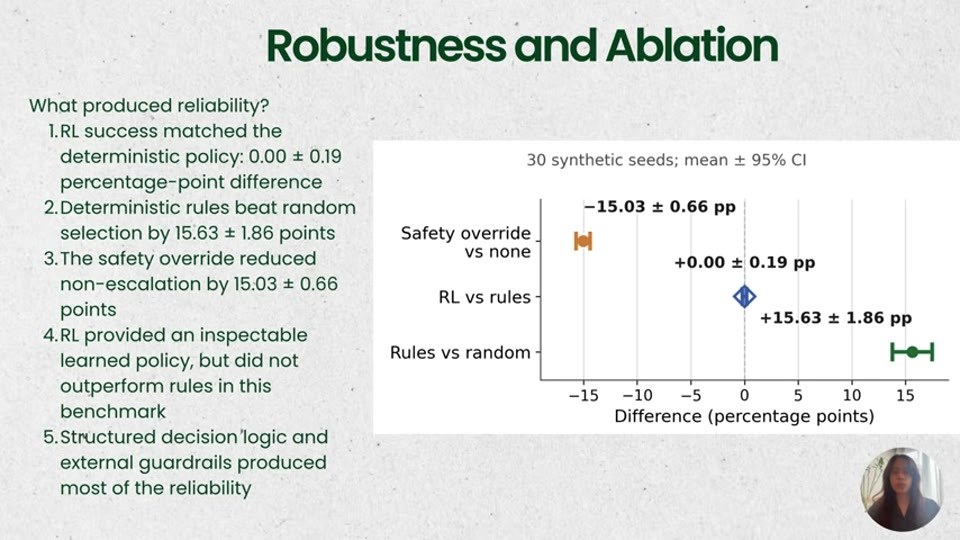
Robustness and Ablation
What produced reliability?
1.RL:success matched the
deterministic pol 100± 30 synthetic seeds; mean ± 95% Cl
2.Deterministic rules beat random percentage-point'difference -15.03 ± 0.66 pp
selection by.15:63 ±'1.86 points Safety override
3.The safety override reduced vs none +0.00 ±:0.19 pp
4.RL provided an inspectable learned policy; butdid not points non-escalation by.15:03:± 0.66 Rules vs random RL vs rules +15.63 ± 1.86 pp
outperform.rules in this -15 -10 -5 0 5 10 15
icnmg Difference (percentage points)
5.Structured decision'logic and
external guardrails produced
nost of the reliability
- Recreated text/layout view: open HTML recreation
- AI slide classifier:
content_slideconfidence0.99 - Text source: agent_vision.
Slide text:
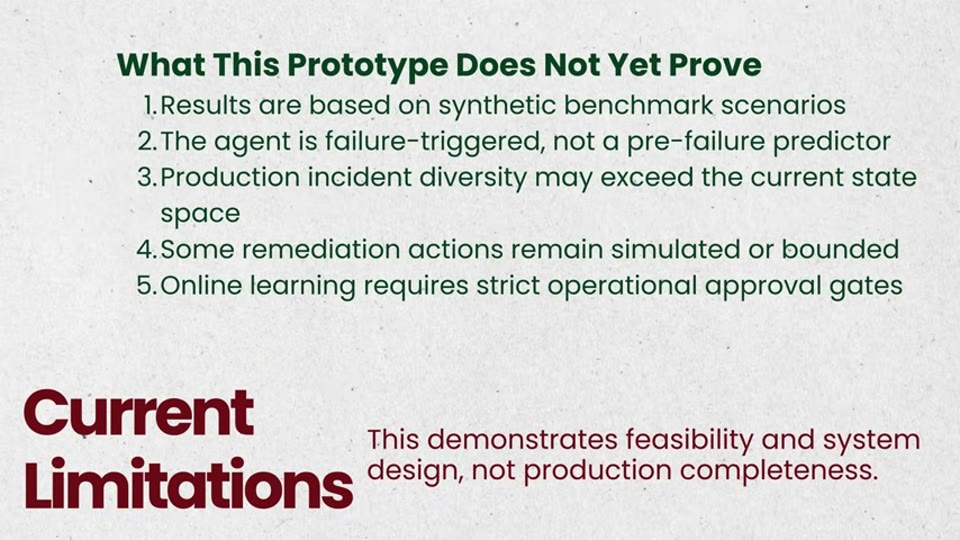
What This Prototype Does Not Yet Prove
1. Results are based on synthetic benchmark scenarios
2. The agent is failure-triggered, not a pre-failure predictor
3. Production incident diversity may exceed the current state space
4. Some remediation actions remain simulated or bounded
5. Online learning requires strict operational approval gates
This demonstrates feasibility and system design, not production completeness.
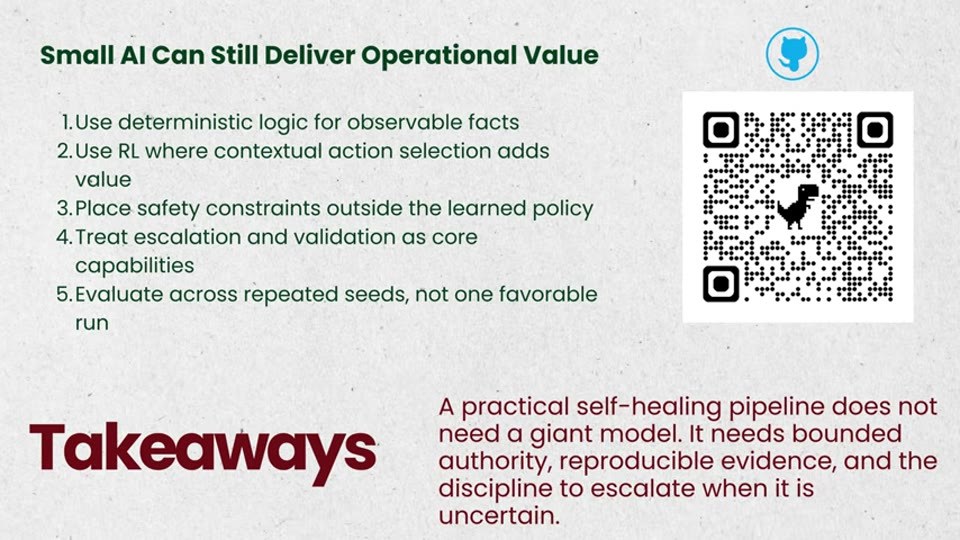
- Recreated text/layout view: open HTML recreation
- AI slide classifier:
content_slideconfidence0.98 - Text source: agent_vision.
Slide text:
Small AI Can Still Deliver Operational Value
1. Use deterministic logic for observable facts
2. Use RL where contextual action selection adds value
3. Place safety constraints outside the learned policy
4. Treat escalation and validation as core capabilities
5. Evaluate across repeated seeds, not one favorable run
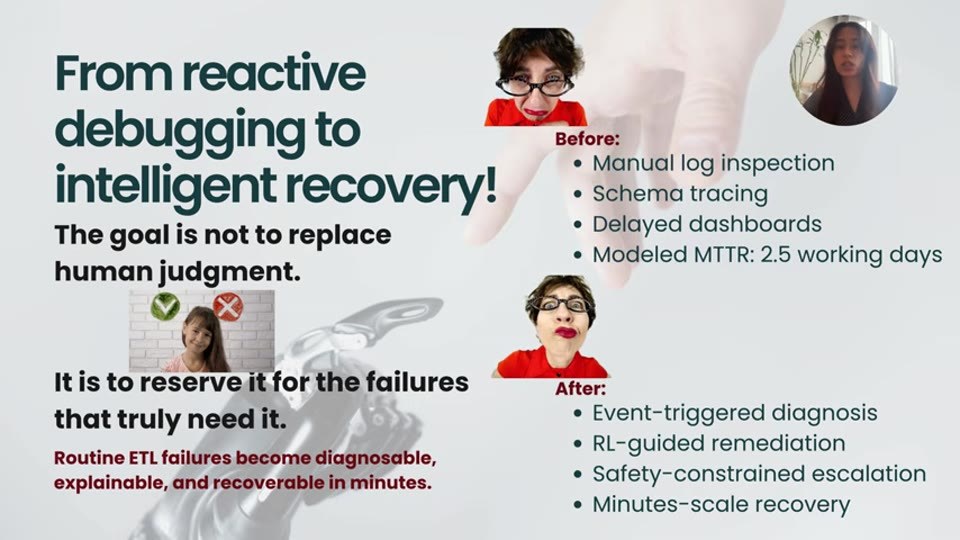
- Recreated text/layout view: open HTML recreation
- AI slide classifier:
content_slideconfidence0.98 - Text source: agent_vision.
Slide text:
From reactive debugging to intelligent recovery!
The goal is not to replace human judgment.
It is to reserve it for the failures that truly need it.
Before:
- Manual log inspection
- Schema tracing
- Delayed dashboards
- Modeled MTTR: 2.5 working days
After:
- Event-triggered diagnosis
- RL-guided remediation
- Safety-constrained escalation
- Minutes-scale recovery
Classification audit: raw/sources/slide-ai-classification/slides/LrGCT7G_rU8/audit.json
Slide-Derived Subjects To Review
Subject extraction uses video title, related session titles/descriptions, transcript context, and OCR text when available. OCR is best-effort and should be reviewed against the embedded slide images.