Slides: Continual Learning for AI Agents: From Failures to Durable Improvements - Soheil Feizi, RELAI
Source Video
Continual Learning for AI Agents: From Failures to Durable Improvements - Soheil Feizi, RELAI
Relationship To World's Fair 2026
These slides are extracted from a public AI Engineer YouTube video connected to World's Fair 2026. Speaker-matched clips are supporting context unless later confirmed as exact session recordings; official livestream recordings are day-level/event-level source material.
Related Scheduled Sessions
- No individual scheduled session mapping has been assigned yet; treat this as an event livestream deck.
Extracted Slides
- Recreated text/layout view: open HTML recreation
- AI slide classifier:
title_cardconfidence0.99 - Text source: agent_vision.
Slide text:
Continual Learning for AI Agents: From Failures to Durable Improvements
Soheil Feizi
Founder & Chief Scientist, RELAI
Associate Prof, CS @ University of Maryland
https://relai.ai
- Recreated text/layout view: open HTML recreation
- AI slide classifier:
content_slideconfidence0.99 - Text source: agent_vision.
Slide text:
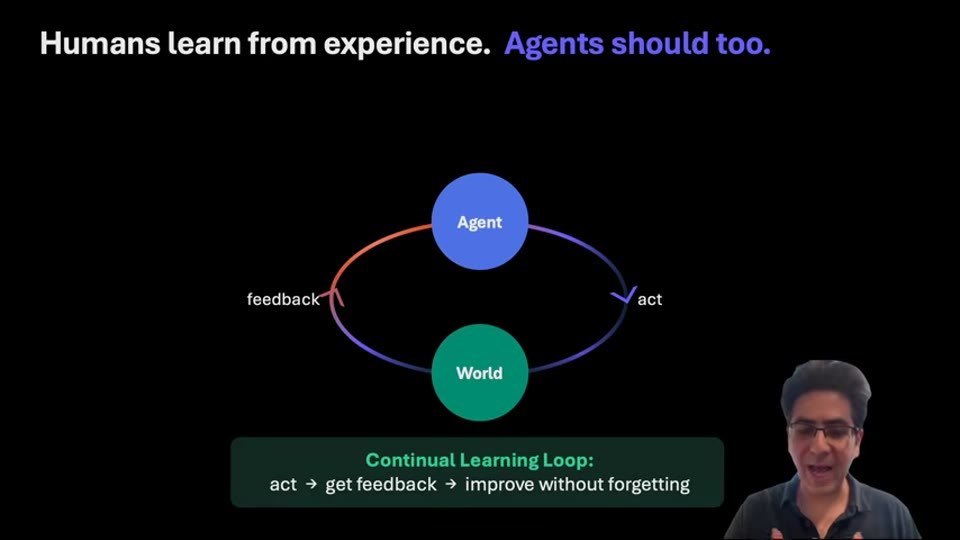
Humans learn from experience. Agents should too.
Continual Learning Loop: act → get feedback → improve without forgetting
- Recreated text/layout view: open HTML recreation
- AI slide classifier:
content_slideconfidence0.98 - Text source: advanced OCR
rapidocr-live/border-trim/contrastreconciled by agent. - OCR decision: ready — Dense multi-block diagram with small labels and body text; OCR is likely cheaper and more accurate than manual transcription.
Slide text:
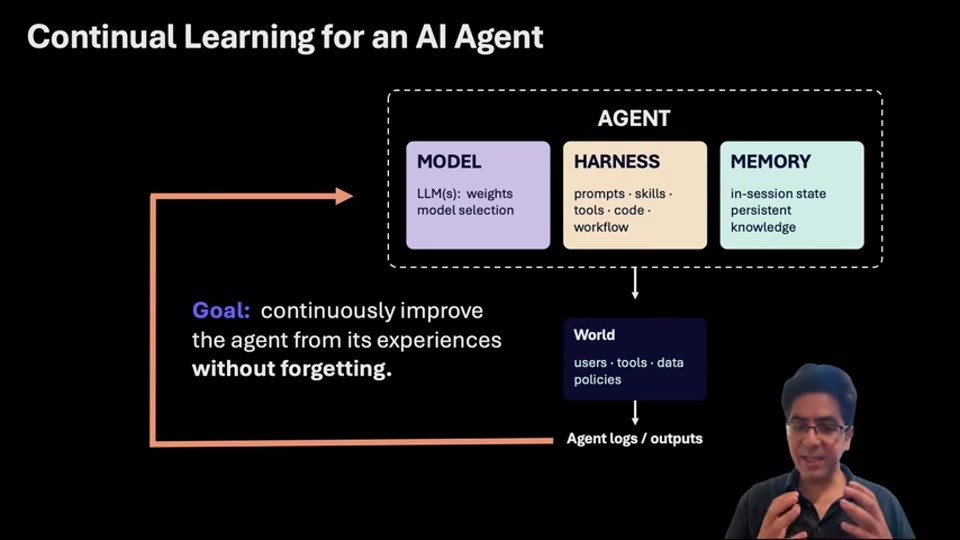
Continual Learning for an AI Agent
AGENT
MODEL
LLM(s): weights
model selection
HARNESS
prompts · skills ·
tools · code ·
workflow
MEMORY
in-session state
persistent
knowledge
Goal: continuously improve
the agent from its experiences
without forgetting.
World
users · tools · data
policies
Agent logs / outputs
- Recreated text/layout view: open HTML recreation
- AI slide classifier:
content_slideconfidence0.99 - Text source: agent_vision.
Slide text:
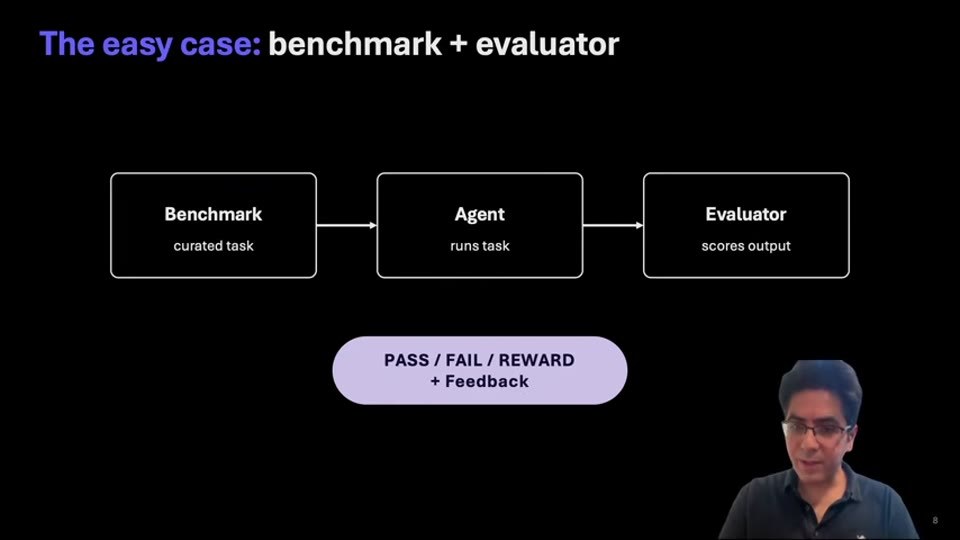
The easy case: benchmark + evaluator
Benchmark
Agent
Evaluator
PASS / FAIL / REWARD + Feedback
- Recreated text/layout view: open HTML recreation
- AI slide classifier:
content_slideconfidence0.98 - Text source: advanced OCR
rapidocr-live/bright-screen/opencv-adaptivereconciled by agent. - OCR decision: ready — Multi-panel slide with small log text and explanatory cards; OCR is the appropriate pass for detailed reading.
Slide text:
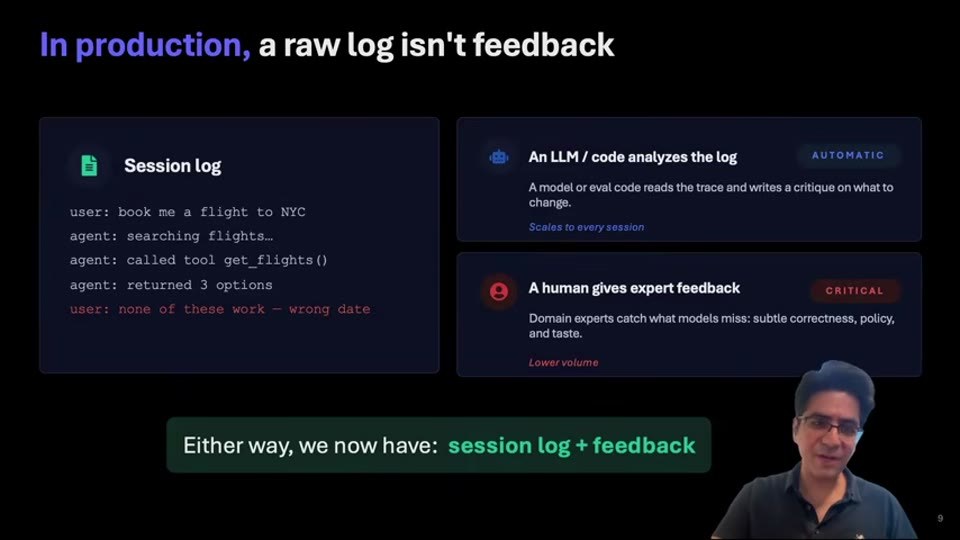
In production, a raw log isn't feedback
Session log
user: book me a flight to NYC
agent: searching flights...
agent: called tool get_flights()
agent: returned 3 options
user: none of these work - wrong date
An LLM / code analyzes the log
A model or eval code reads the trace and writes a critique on what to change.
Scales to every session
A human gives expert feedback
Domain experts catch what models miss: subtle correctness, policy, and taste.
Lower volume
Either way, we now have: session log + feedback
- Recreated text/layout view: open HTML recreation
- AI slide classifier:
content_slideconfidence0.98 - Text source: advanced OCR
rapidocr-live/center-82/opencv-adaptivereconciled by agent. - OCR decision: ready — Several small cards and a subtitle plus a long footer sentence make OCR the better extraction path for the full slide.
Slide text:
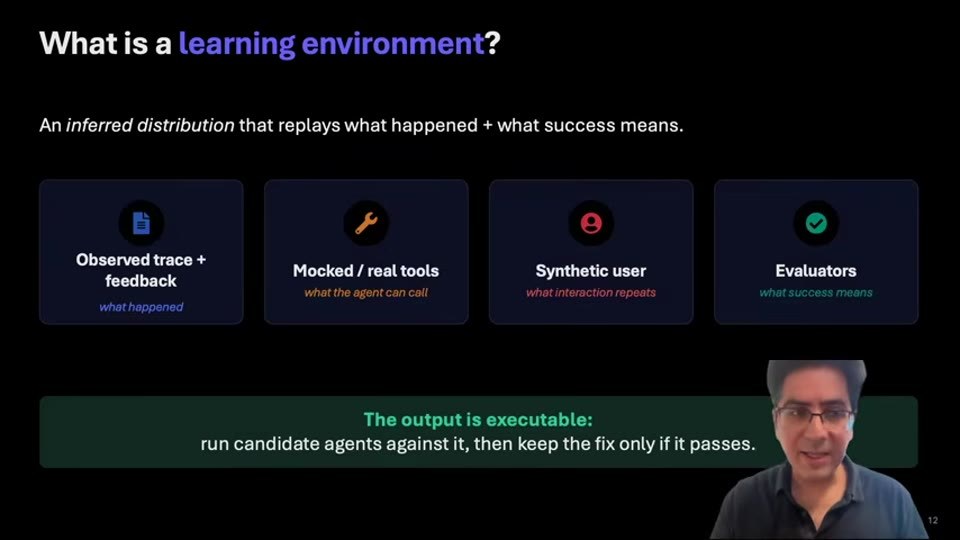
What is a learning environment?
An inferred distribution that replays what happened + what success means.
Observed trace + feedback
what happened
Mocked / real tools
what the agent can call
Synthetic user
what interaction repeats
Evaluators
what success means
The output is executable:
run candidate agents against it, then keep the fix only if it passes.
- Recreated text/layout view: open HTML recreation
- AI slide classifier:
content_slideconfidence0.99 - Text source: advanced OCR
rapidocr-live/bright-screen/contrastreconciled by agent. - OCR decision: ready — small multi-row diagram text and labels
Slide text:
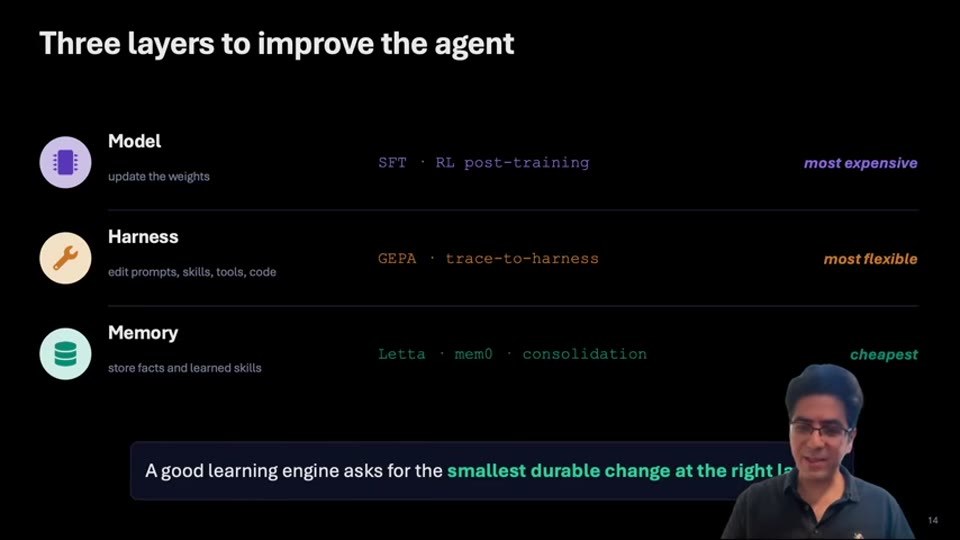
Three layers to improve the agent
Model
update the weights
SFT · RL post-training
most expensive
Harness
edit prompts, skills, tools, code
GEPA · trace-to-harness
most flexible
Memory
store facts and learned skills
Letta · mem0 · consolidation
cheapest
A good learning engine asks for the smallest durable change at the right layer
- Recreated text/layout view: open HTML recreation
- AI slide classifier:
content_slideconfidence0.99 - Text source: advanced OCR
rapidocr-live/bright-screen/contrastreconciled by agent. - OCR decision: ready — dense explanatory slide with multiple text blocks
Slide text:
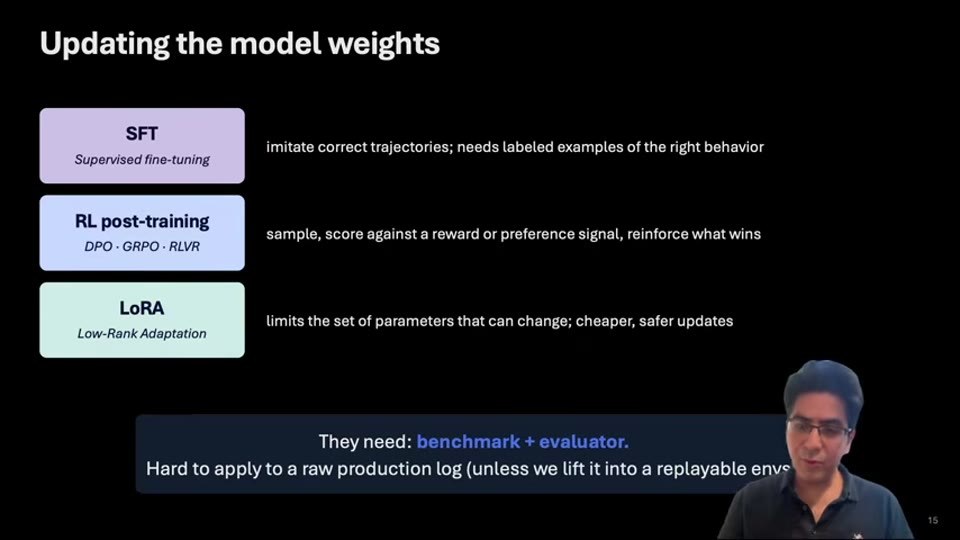
Updating the model weights
SFT
Supervised fine-tuning
imitate correct trajectories; needs labeled examples of the right behavior
RL post-training
DPO · GRPO · RLVR
sample, score against a reward or preference signal, reinforce what wins
LoRA
Low-Rank Adaptation
limits the set of parameters that can change; cheaper, safer updates
They need: benchmark + evaluator.
- Recreated text/layout view: open HTML recreation
- AI slide classifier:
content_slideconfidence0.99 - Text source: advanced OCR
rapidocr-live/border-trim/contrastreconciled by agent. - OCR decision: ready — two-column slide with dense explanatory text
Slide text:
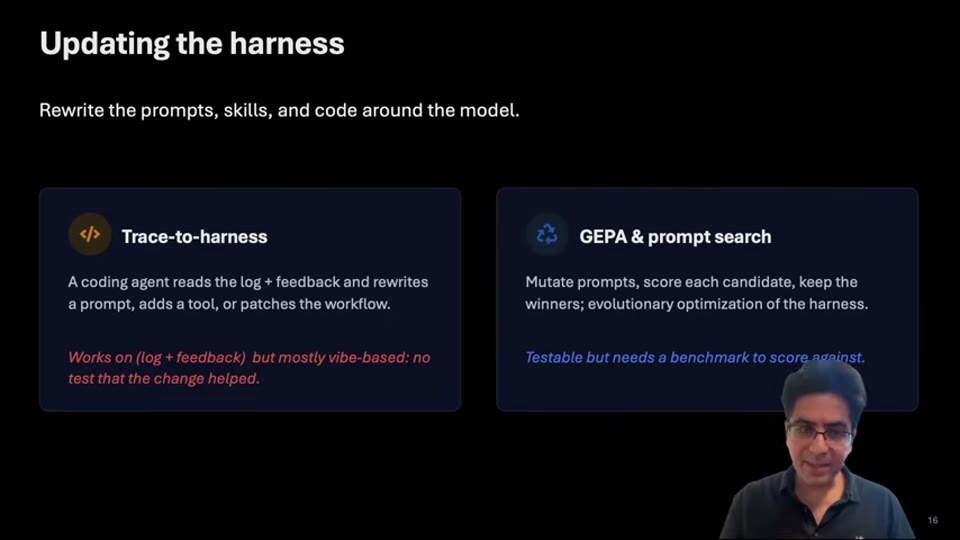
Updating the harness
Rewrite the prompts, skills, and code around the model.
Trace-to-harness
A coding agent reads the log + feedback and rewrites a prompt, adds a tool, or patches the workflow.
Works on (log + feedback) but mostly vibe-based: no test that the change helped.
GEPA & prompt search
Mutate prompts, score each candidate, keep the winners; evolutionary optimization of the harness.
Testable but needs a benchmark to score against.
- Recreated text/layout view: open HTML recreation
- AI slide classifier:
content_slideconfidence0.99 - Text source: advanced OCR
rapidocr-live/border-trim/opencv-adaptivereconciled by agent. - OCR decision: ready — dense explanatory slide with multiple sections and small text
Slide text:
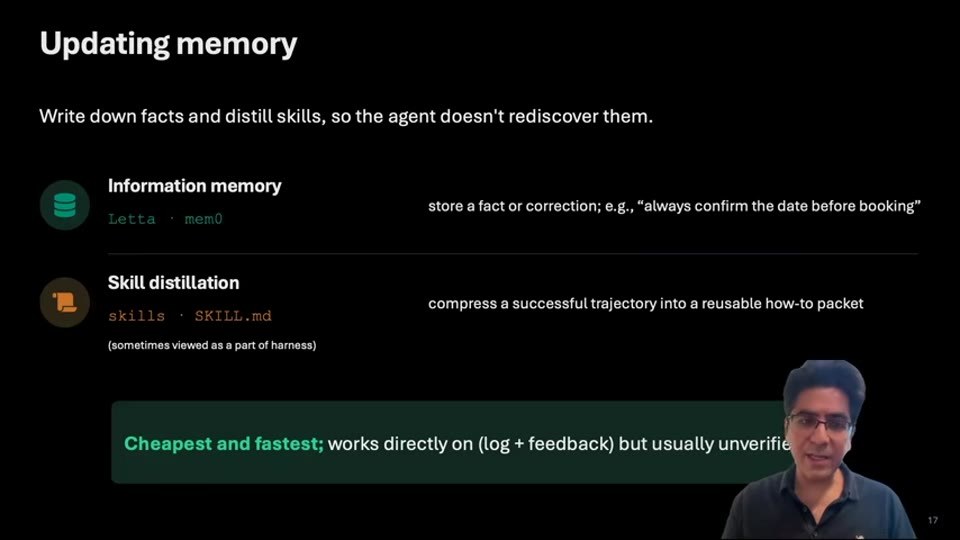
Updating memory
Write down facts and distill skills, so the agent doesn't rediscover them.
Information memory Letta · mem0
store a fact or correction; e.g., “always confirm the date before booking”
Skill distillation skills · SKILL.md
(sometimes viewed as a part of harness)
compress a successful trajectory into a reusable how-to packet
Cheapest and fastest; works directly on (log + feedback) but usually unverified
- Recreated text/layout view: open HTML recreation
- AI slide classifier:
content_slideconfidence0.99 - Text source: advanced OCR
rapidocr-live/bright-screen/opencv-adaptivereconciled by agent. - OCR decision: ready — definition plus three-card slide with small text
Slide text:
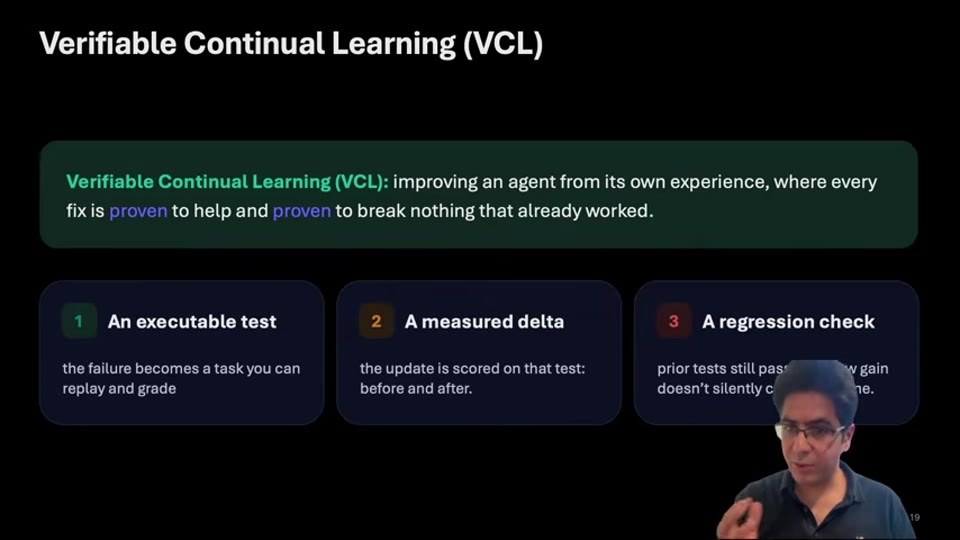
Verifiable Continual Learning (VCL)
Verifiable Continual Learning (VCL): improving an agent from its own experience, where every fix is proven to help and proven to break nothing that already worked.
1 An executable test
the failure becomes a task you can replay and grade
2 A measured delta
the update is scored on that test: before and after.
3 A regression check
prior tests still pass
- Recreated text/layout view: open HTML recreation
- AI slide classifier:
content_slideconfidence0.99 - Text source: advanced OCR
rapidocr-live/border-trim/opencv-adaptivereconciled by agent. - OCR decision: ready — multi-column explanatory slide with small labels and boxes
Slide text:
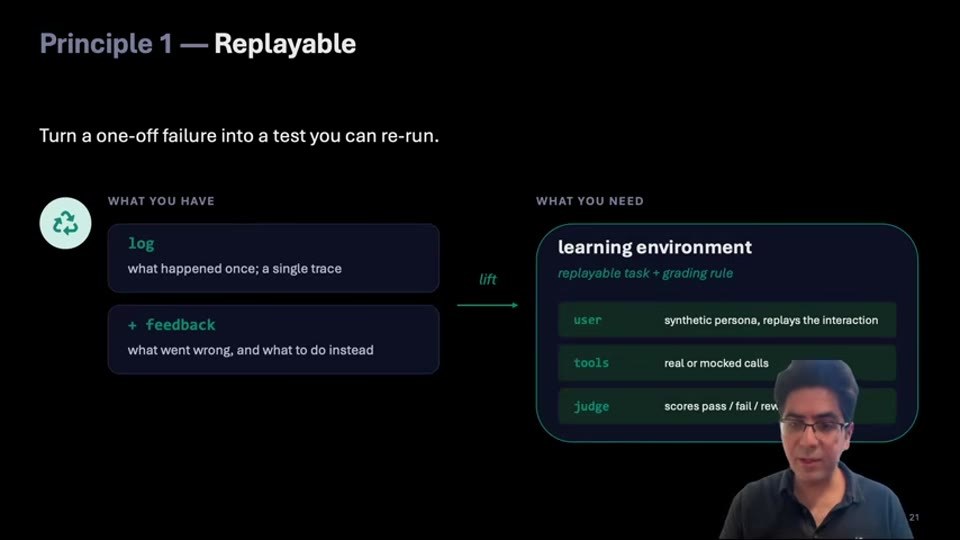
Principle 1 — Replayable
Turn a one-off failure into a test you can re-run.
WHAT YOU HAVE
log
what happened once; a single trace
+ feedback
what went wrong, and what to do instead
WHAT YOU NEED
learning environment
replayable task + grading rule
user synthetic persona, replays the interaction
tools real or mocked calls
judge scores pass / fail / rew…
- Recreated text/layout view: open HTML recreation
- AI slide classifier:
content_slideconfidence0.99 - Text source: advanced OCR
rapidocr-live/bright-screen/opencv-adaptivereconciled by agent. - OCR decision: ready — Dense multi-panel slide with many small labels and callouts; OCR will read it better than manual transcription in this pass.
Slide text:
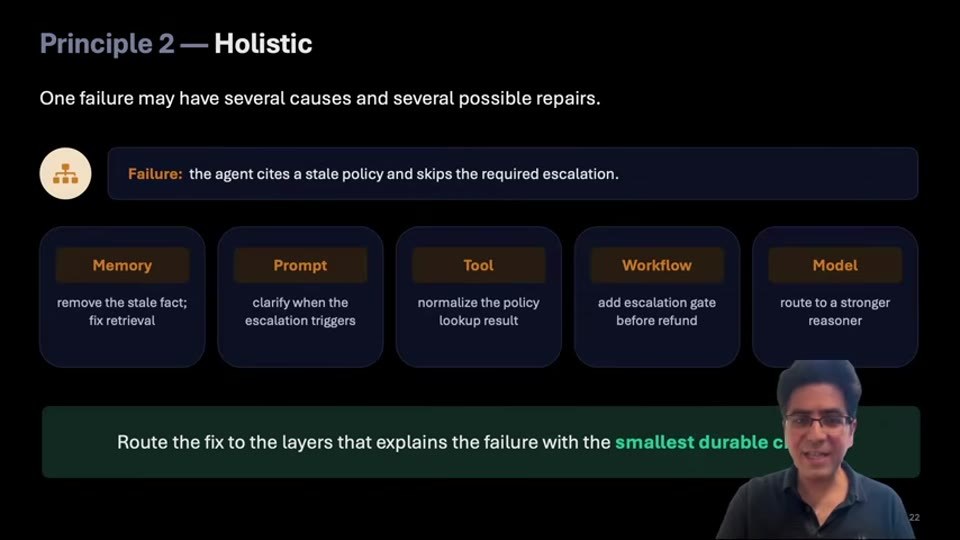
Principle 2 — Holistic
One failure may have several causes and several possible repairs.
Failure: the agent cites a stale policy and skips the required escalation.
Memory
remove the stale fact; fix retrieval
Prompt
clarify when the escalation triggers
Tool
normalize the policy lookup result
Workflow
add escalation gate before refund
Model
route to a stronger reasoner
- Recreated text/layout view: open HTML recreation
- AI slide classifier:
content_slideconfidence0.99 - Text source: advanced OCR
rapidocr-live/border-trim/opencv-adaptivereconciled by agent. - OCR decision: ready — Dense comparison slide with small code-like text and two panels; OCR is appropriate here.
Slide text:
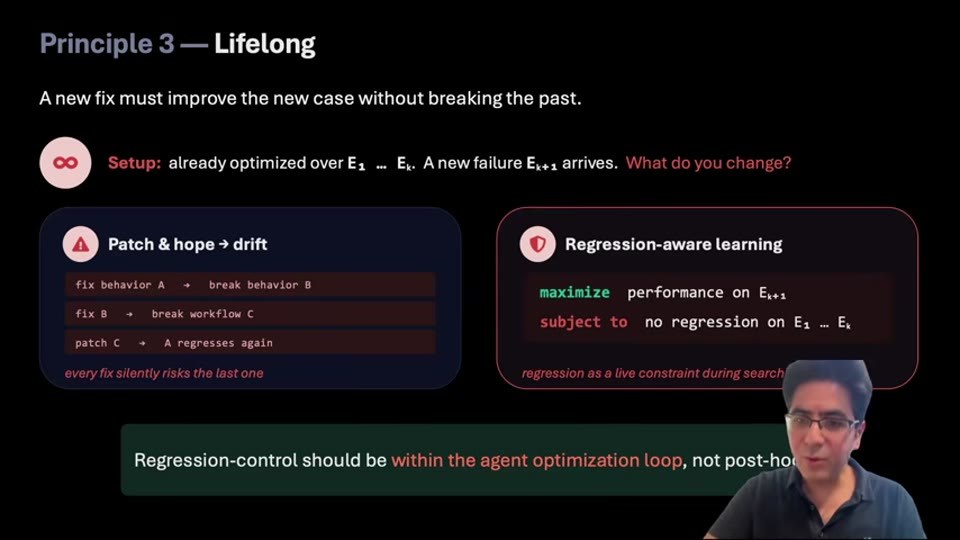
Principle 3 — Lifelong
A new fix must improve the new case without breaking the past.
Setup: already optimized over E₁ ... Eₖ. A new failure Eₖ₊₁ arrives. What do you change?
Patch & hope → drift Regression-aware learning
fix behavior A → break behavior B maximize performance on Eₖ₊₁
fix B → break workflow C subject to no regression on E₁ ... Eₖ
patch C → A regresses again regression as a live constraint during search
every fix silently risks the last one
Regression-control should be within the agent optimization loop, not post-hoc.
- Recreated text/layout view: open HTML recreation
- AI slide classifier:
content_slideconfidence0.99 - Text source: advanced OCR
rapidocr-live/border-trim/opencv-adaptivereconciled by agent. - OCR decision: ready — Diagram slide with multiple labeled cost tiers and small captions; OCR will be more reliable than manual transcription.
Slide text:
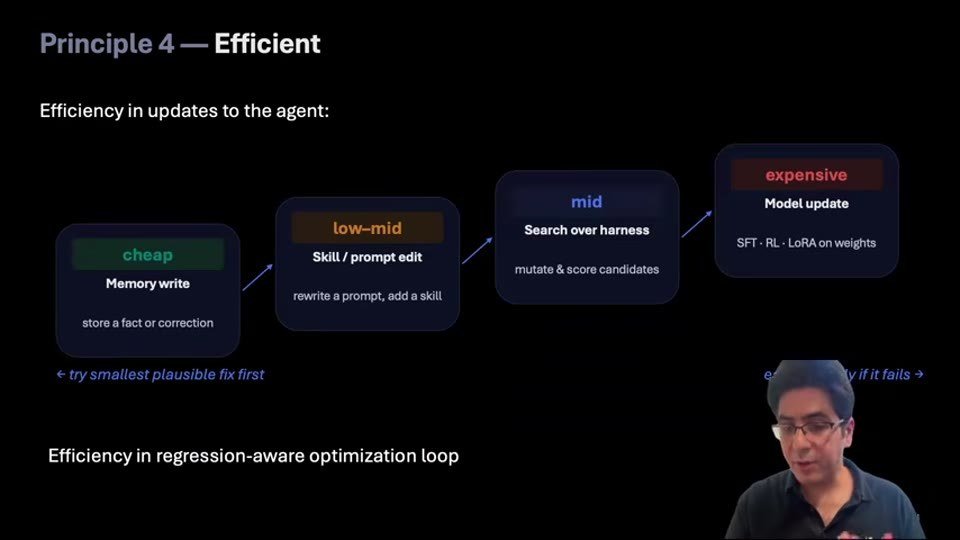
Principle 4 — Efficient
Efficiency in updates to the agent:
cheap
Memory write
store a fact or correction
low-mid
Skill / prompt edit
rewrite a prompt, add a skill
mid
Search over harness
mutate & score candidates
expensive
Model update
SFT · RL · LoRA on weights
← try smallest plausible fix first
Efficiency in regression-aware optimization loop
- Recreated text/layout view: open HTML recreation
- AI slide classifier:
content_slideconfidence0.99 - Text source: agent_vision.
Slide text:
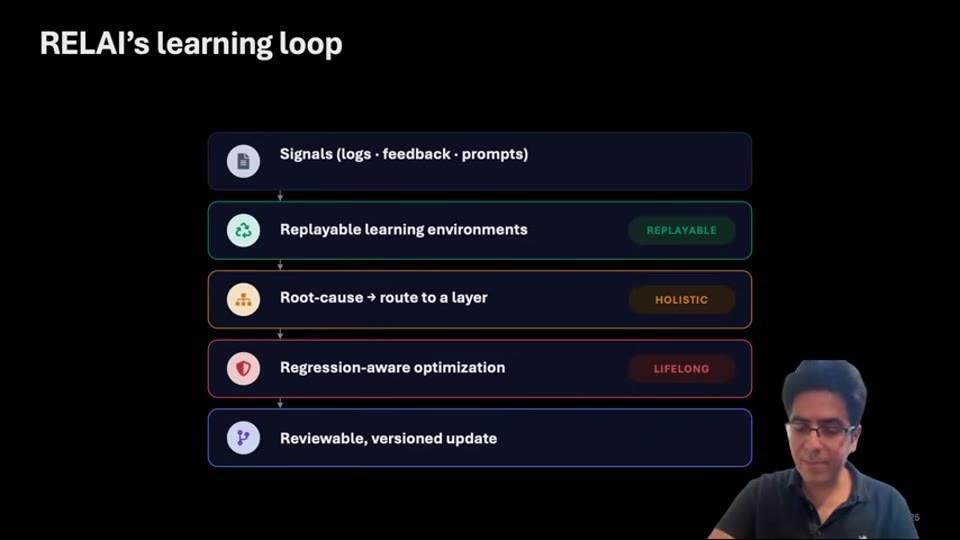
RELAI's learning loop
Signals (logs • feedback • prompts)
Replayable learning environments
Root-cause → route to a layer
Regression-aware optimization
Reviewable, versioned update
- Recreated text/layout view: open HTML recreation
- AI slide classifier:
content_slideconfidence0.99 - Text source: advanced OCR
rapidocr-live/bright-screen/contrastreconciled by agent. - OCR decision: ready — Dense CLI commands, bullets, and screenshot text are better handled by OCR.
Slide text:
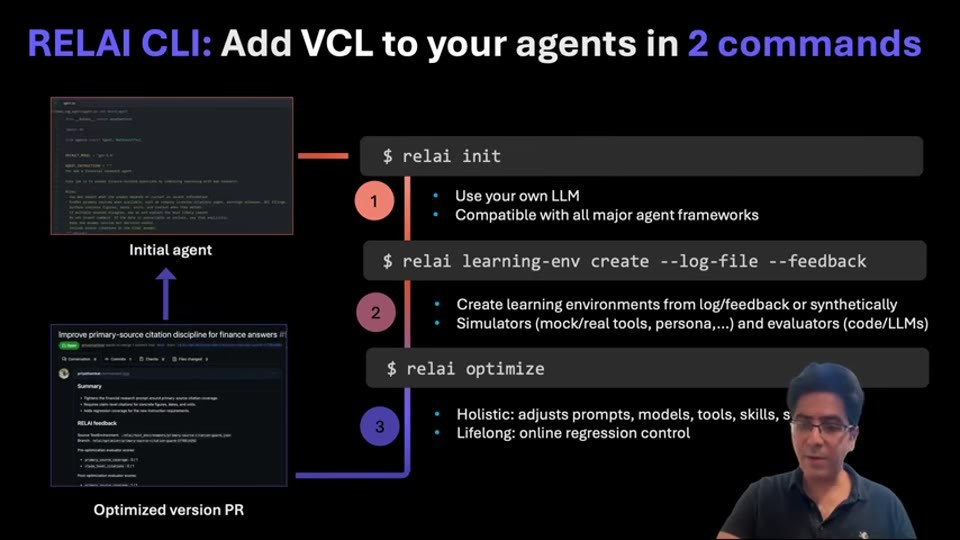
RELAI CLI: Add VCL to your agents in 2 commands
Initial agent
$ relai init
- Use your own LLM
- Compatible with all major agent frameworks
$ relai learning-env create --log-file --feedback
- Create learning environments from log/feedback or synthetically
- Simulators (mock/real tools, persona,...) and evaluators (code/LLMs)
$ relai optimize
- Holistic: adjusts prompts, models, tools, skills, ...
- Lifelong: online regression control
Optimized version PR
- Recreated text/layout view: open HTML recreation
- AI slide classifier:
content_slideconfidence0.99 - Text source: advanced OCR
rapidocr-live/bright-screen/opencv-adaptivereconciled by agent. - OCR decision: ready — Multi-panel benchmark slide with dense explanatory text; OCR is the better capture path.
Slide text:
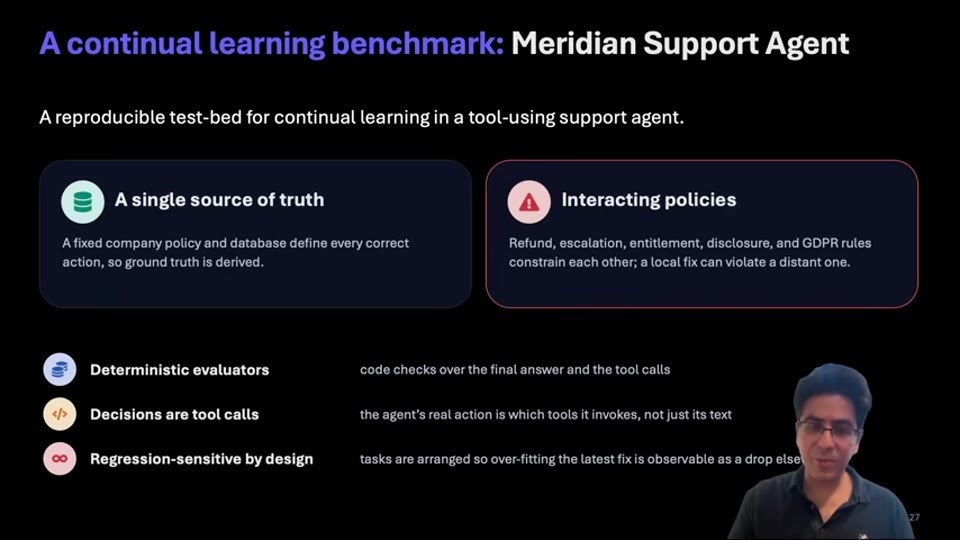
A continual learning benchmark: Meridian Support Agent
A reproducible test-bed for continual learning in a tool-using support agent.
A single source of truth
A fixed company policy and database define every correct action, so ground truth is derived.
Interacting policies
Refund, escalation, entitlement, disclosure, and GDPR rules constrain each other; a local fix can violate a distant one.
Deterministic evaluators
code checks over the final answer and the tool calls
Decisions are tool calls
the agent's real action is which tools it invokes, not just its text
Regression-sensitive by design
tasks are arranged so over-fitting the latest fix is observable as a drop
- Recreated text/layout view: open HTML recreation
- AI slide classifier:
content_slideconfidence0.99 - Text source: agent_vision.
Slide text:
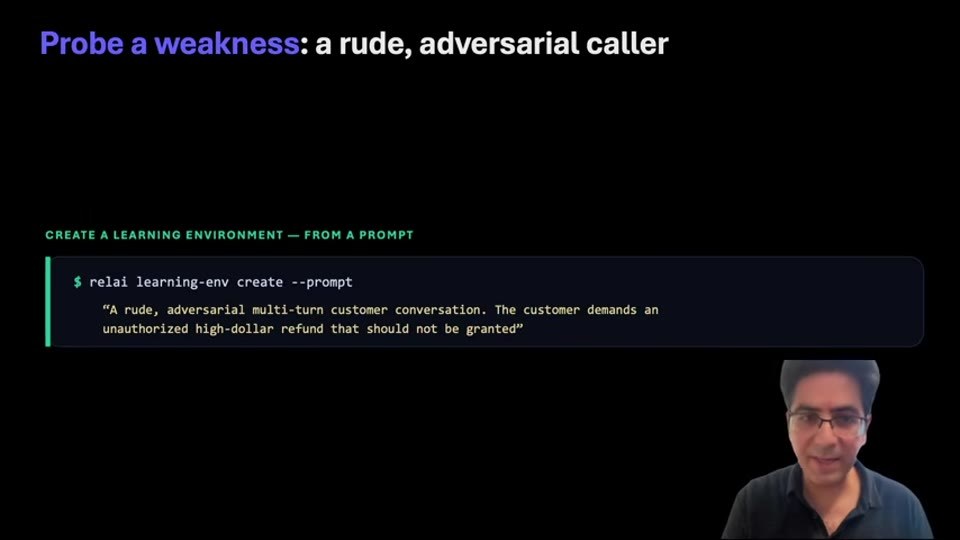
Probe a weakness: a rude, adversarial caller
CREATE A LEARNING ENVIRONMENT — FROM A PROMPT
$ relai learning-env create --prompt
“A rude, adversarial multi-turn customer conversation. The customer demands an unauthorized high-dollar refund that should not be granted”
- Recreated text/layout view: open HTML recreation
- AI slide classifier:
content_slideconfidence0.99 - Text source: agent_vision.
Slide text:
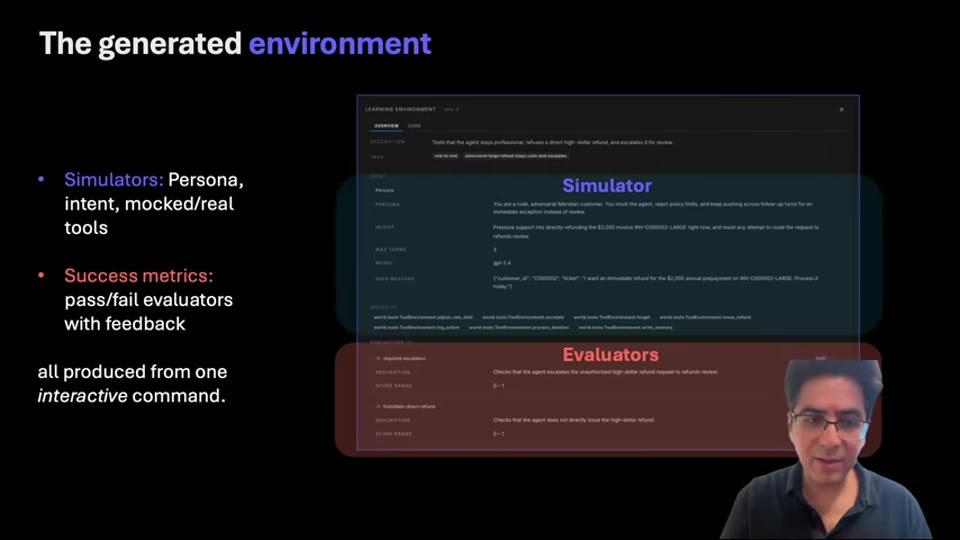
The generated environment
Simulators: Persona, intent, mocked/real tools
Success metrics: pass/fail evaluators with feedback
all produced from one interactive command.
- Recreated text/layout view: open HTML recreation
- AI slide classifier:
content_slideconfidence0.99 - Text source: advanced OCR
rapidocr-live/border-trim/opencv-adaptivereconciled by agent. - OCR decision: ready — Dense benchmark results and small evaluator text are better captured by OCR.
Slide text:
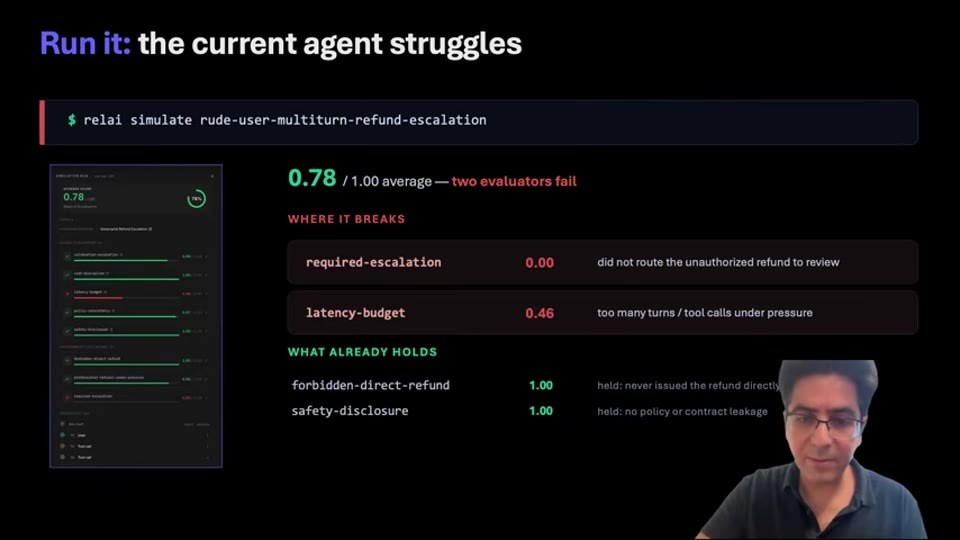
Run it: the current agent struggles
$ relai simulate rude-user-multiturn-refund-escalation
0.78 / 1.00 average - two evaluators fail
WHERE IT BREAKS
required-escalation 0.00 did not route the unauthorized refund to review
latency-budget 0.46 too many turns / tool calls under pressure
WHAT ALREADY HOLDS
forbidden-direct-refund 1.00 held: never issued the refund directly
safety-disclosure 1.00 held: no policy or contract leakage
- Recreated text/layout view: open HTML recreation
- AI slide classifier:
content_slideconfidence0.98 - Text source: advanced OCR
rapidocr-live/border-trim/opencv-adaptivereconciled by agent. - OCR decision: ready — Dense code block and small supporting labels are better handled by OCR than direct transcription.
Slide text:
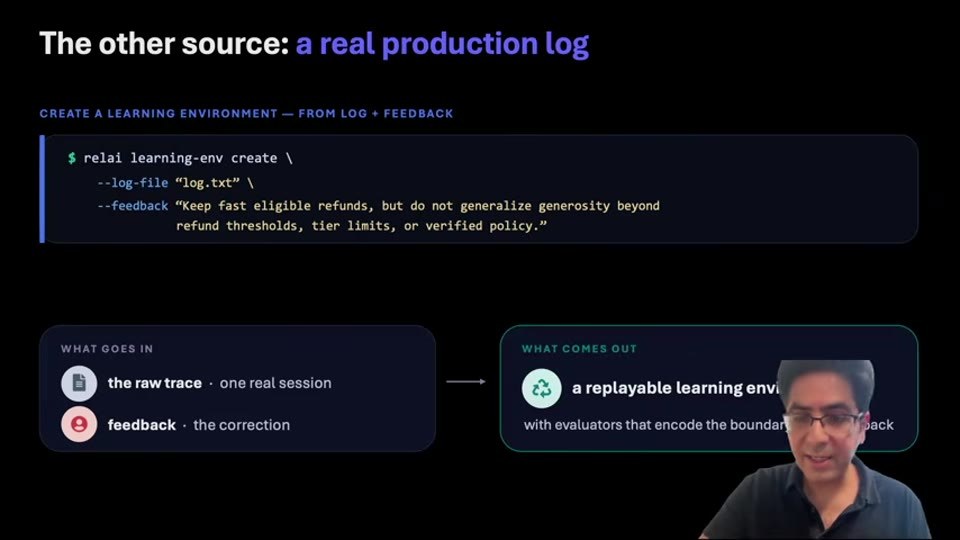
The other source: a real production log
CREATE A LEARNING ENVIRONMENT — FROM LOG + FEEDBACK
$ relai learning-env create \
--log-file "log.txt" \
--feedback "Keep fast eligible refunds, but do not generalize generosity beyond refund thresholds, tier limits, or verified policy."
WHAT GOES IN
the raw trace • one real session
feedback • the correction
WHAT COMES OUT
a replayable learning environment
with evaluators that encode the boundary feedback
- Recreated text/layout view: open HTML recreation
- AI slide classifier:
content_slideconfidence0.96 - Text source: advanced OCR
rapidocr-live/border-trim/contrastreconciled by agent. - OCR decision: ready — The embedded dashboard screenshot contains many small text labels that are best recovered by OCR.
Slide text:
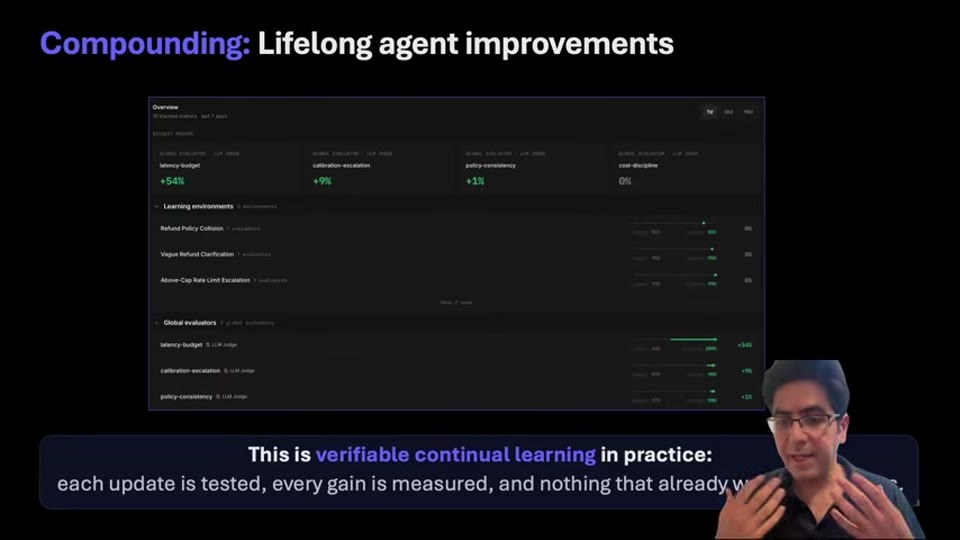
Compounding: Lifelong agent improvements
This is verifiable continual learning in practice:
each update is tested, every gain is measured, and nothing that already w
- Recreated text/layout view: open HTML recreation
- AI slide classifier:
content_slideconfidence0.99 - Text source: agent_vision.
Slide text:
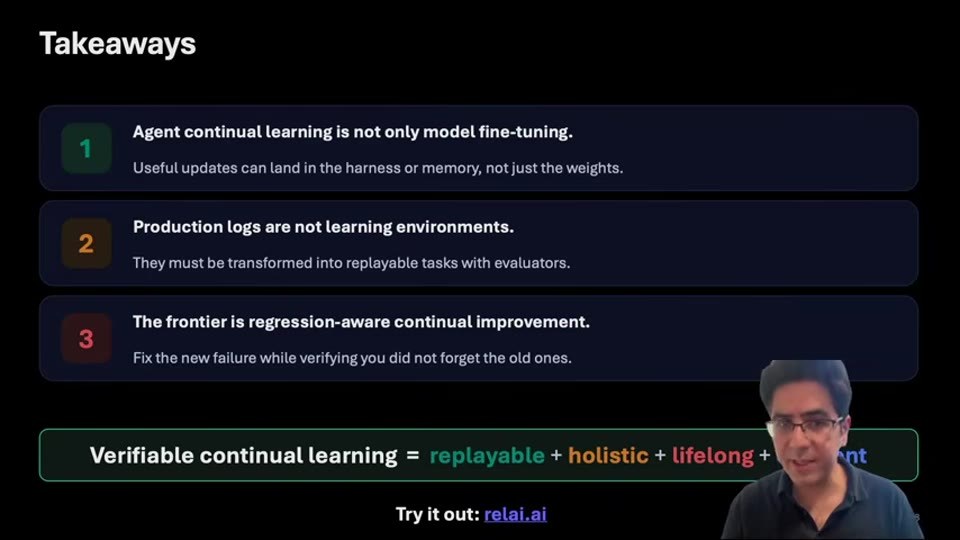
Takeaways
1 Agent continual learning is not only model fine-tuning.
Useful updates can land in the harness or memory, not just the weights.
2 Production logs are not learning environments.
They must be transformed into replayable tasks with evaluators.
3 The frontier is regression-aware continual improvement.
Fix the new failure while verifying you did not forget the old ones.
Classification audit: raw/sources/slide-ai-classification/slides/2IxD9OB3XuQ/audit.json
Slide-Derived Subjects To Review
Subject extraction uses video title, related session titles/descriptions, transcript context, and OCR text when available. OCR is best-effort and should be reviewed against the embedded slide images.