Dense Slides: DSPy: The End of Prompt Engineering - Kevin Madura, AlixPartners
Source Video
DSPy: The End of Prompt Engineering - Kevin Madura, AlixPartners
Method
This deck is slide-only. The existing captured video frame set supplies candidate frames, then local OpenCV rejects sponsor/title/speaker-only frames, crops visible slide surfaces, deduplicates, and saves the cropped slide images.
Cropped Visible Slides
- Recreated text/layout view: open HTML recreation
- AI slide classifier:
content_slideconfidence0.98 - Text source: agent_vision.
Slide text:
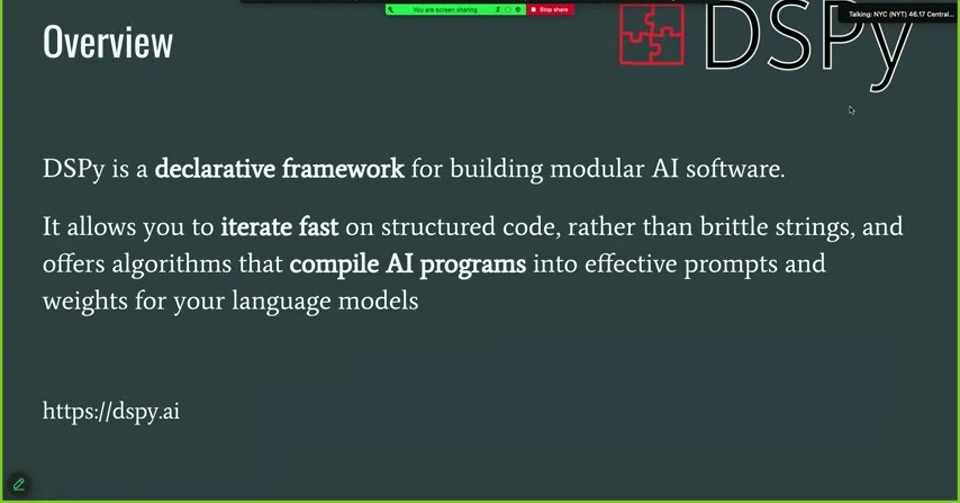
Overview
DSPy is a declarative framework for building modular AI software.
It allows you to iterate fast on structured code, rather than brittle strings, and offers algorithms that compile AI programs into effective prompts and weights for your language models
https://dspy.ai
- Recreated text/layout view: open HTML recreation
- AI slide classifier:
content_slideconfidence0.98 - Text source: agent_vision.
Slide text:
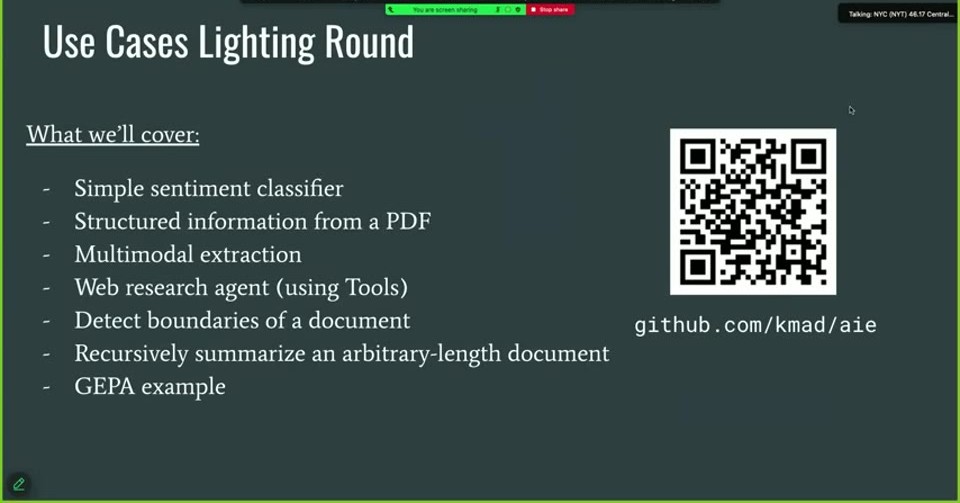
Use Cases Lighting Round
What we’ll cover:
- Simple sentiment classifier
- Structured information from a PDF
- Multimodal extraction
- Web research agent (using Tools)
- Detect boundaries of a document
- Recursively summarize an arbitrary-length document
- GEPA example
- Recreated text/layout view: open HTML recreation
- AI slide classifier:
content_slideconfidence0.97 - Text source: agent_vision.
Slide text:
DSPy allows you to decompose logic into a program that treats LLMs as a first class citizen ...
... without having to tweak prompts (unless you want to)
- Recreated text/layout view: open HTML recreation
- AI slide classifier:
content_slideconfidence0.93 - Text source: advanced OCR
rapidocr-live/bright-screen/contrastreconciled by agent. - OCR decision: ready — Dense small bullet text on the right and a cropped top line make OCR more appropriate than direct transcription.
Slide text:
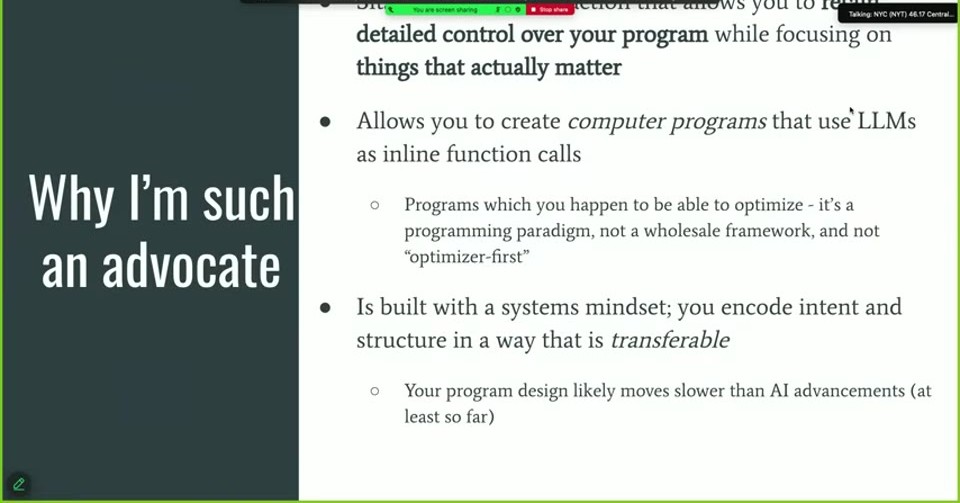
Why I'm such
an advocate
Allows you to create computer programs that use LLMs
as inline function calls
Programs which you happen to be able to optimize - it's a
programming paradigm, not a wholesale framework, and not
“optimizer-first”
Is built with a systems mindset; you encode intent and
structure in a way that is transferable
Your program design likely moves slower than AI advancements (at
least so far)
- Recreated text/layout view: open HTML recreation
- AI slide classifier:
content_slideconfidence0.97 - Text source: advanced OCR
rapidocr-live/bright-screen/opencv-adaptivereconciled by agent. - OCR decision: ready — Diagram-style slide with six text boxes and small labels is better suited to OCR extraction.
Slide text:
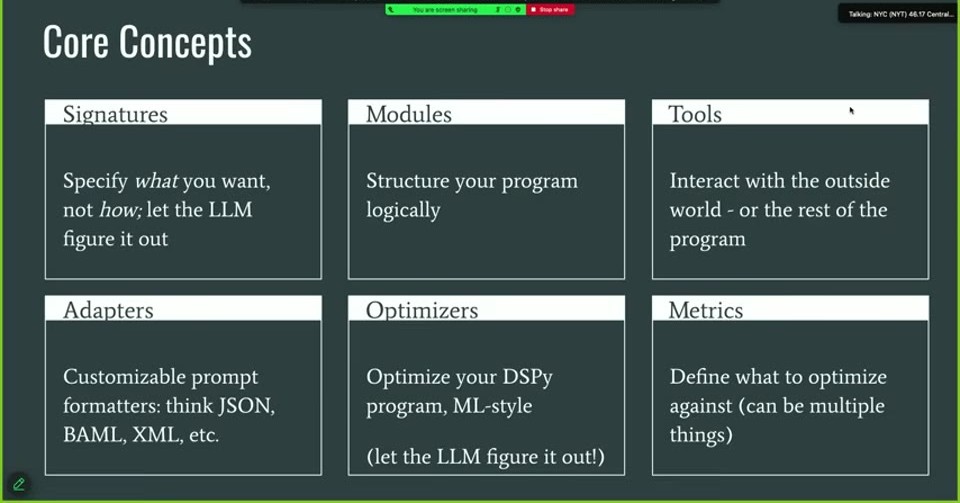
Core Concepts
Signatures
Specify what you want,
not how; let the LLM
figure it out
Modules
Structure your program
logically
Tools
Interact with the outside
world - or the rest of the
program
Adapters
Customizable prompt
formatters: think JSON,
BAML, XML, etc.
Optimizers
Optimize your DSPy
program, ML-style
(let the LLM figure it out!)
Metrics
Define what to optimize
against (can be multiple
things)
- Recreated text/layout view: open HTML recreation
- AI slide classifier:
content_slideconfidence0.98 - Text source: agent_vision.
Slide text:
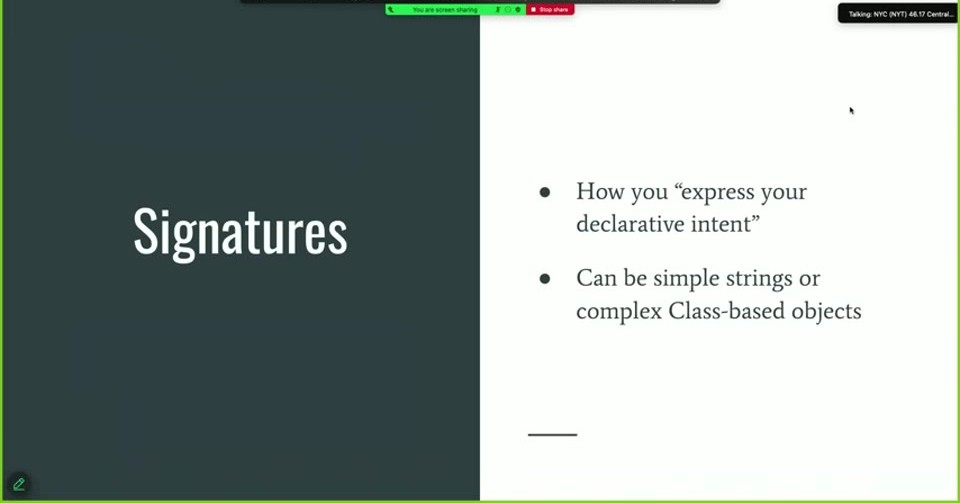
Signatures
How you “express your declarative intent”
Can be simple strings or complex Class-based objects
- Recreated text/layout view: open HTML recreation
- AI slide classifier:
content_slideconfidence0.98 - Text source: agent_vision.
Slide text:
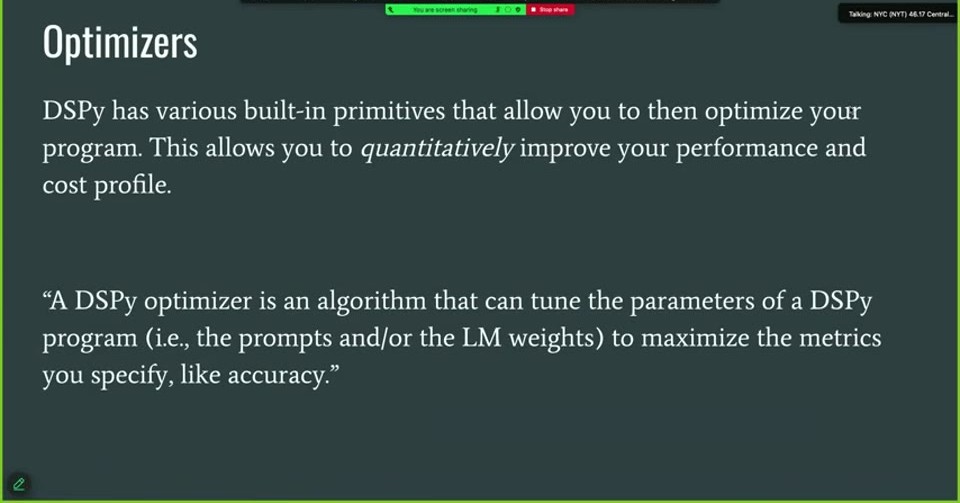
Optimizers
DSPy has various built-in primitives that allow you to then optimize your program. This allows you to quantitatively improve your performance and cost profile.
“A DSPy optimizer is an algorithm that can tune the parameters of a DSPy program (i.e., the prompts and/or the LM weights) to maximize the metrics you specify, like accuracy.”
- Recreated text/layout view: open HTML recreation
- AI slide classifier:
content_slideconfidence0.99 - Text source: agent_vision.
Slide text:
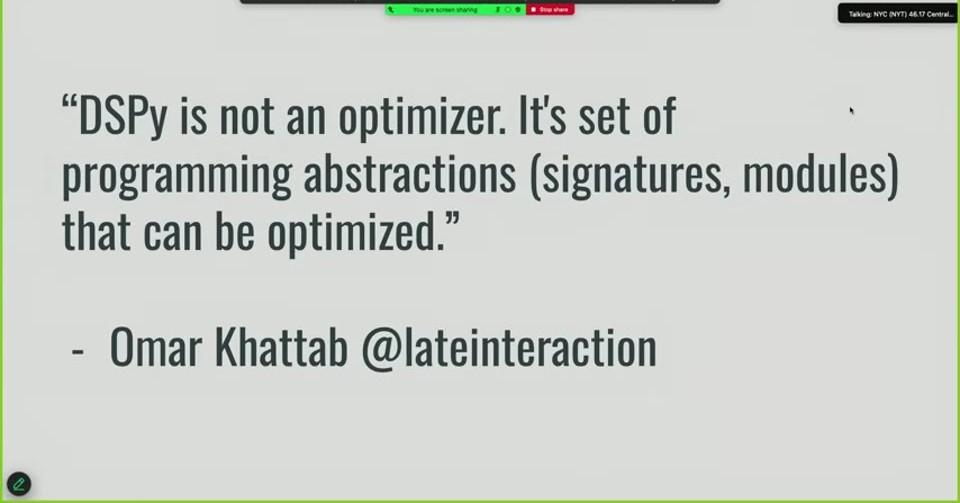
“DSPy is not an optimizer. It’s set of programming abstractions (signatures, modules) that can be optimized.”
- Omar Khattab @lateinteraction
- Recreated text/layout view: open HTML recreation
- AI slide classifier:
content_slideconfidence0.96 - Text source: agent_vision.
Slide text:
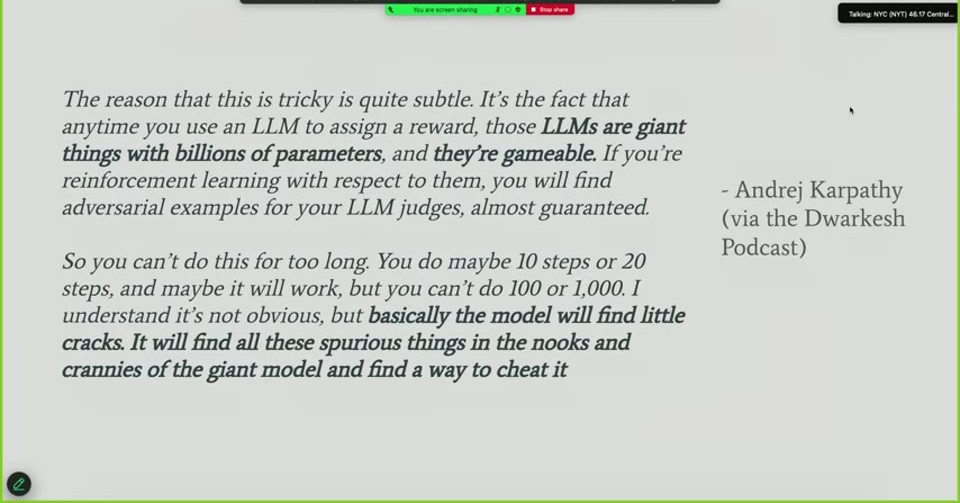
The reason that this is tricky is quite subtle. It’s the fact that
anytime you use an LLM to assign a reward, those LLMs are giant
things with billions of parameters, and they’re gameable. If you’re
reinforcement learning with respect to them, you will find
adversarial examples for your LLM judges, almost guaranteed.
So you can’t do this for too long. You do maybe 10 steps or 20
steps, and maybe it will work, but you can’t do 100 or 1,000. I
understand it’s not obvious, but basically the model will find little
cracks. It will find all these spurious things in the nooks and
crannies of the giant model and find a way to cheat it
- Andrej Karpathy (via the Dwarkesh Podcast)
- Recreated text/layout view: open HTML recreation
- AI slide classifier:
content_slideconfidence0.99 - Text source: advanced OCR
rapidocr-live/bright-screen/contrastreconciled by agent. - OCR decision: ready — Dense slide with paper title, author list, table, and caption; OCR is better suited than direct transcription in this triage pass.
Slide text:
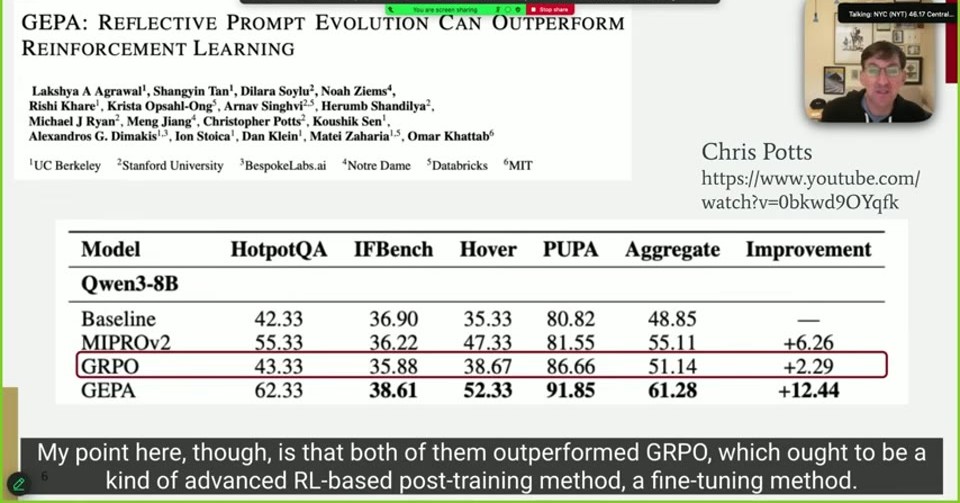
GEPA: Reflective Prompt Evolution Can Outperform
Reinforcement Learning
Lakshya A Agrawal, Shangyin Tan, Dilara Soylu, Noah Ziems, Rishi Khare, Krista Opsahl-Ong, Arnav Singhvi, Herumb Shandilya, Michael J Ryan, Meng Jiang, Christopher Potts, Koushik Sen, Alexandros G. Dimakis, Ion Stoica, Dan Klein, Matei Zaharia, Omar Khattab
UC Berkeley, Stanford University, BespokeLabs.ai, Notre Dame, Databricks, MIT
Chris Potts
https://www.youtube.com/watch?v=0bkwd9OYqfk
Model HotpotQA IFBench Hover PUPA Aggregate Improvement
Qwen3-8B
Baseline 42.33 36.90 35.33 80.82 48.85 —
MIPROv2 55.33 36.22 47.33 81.55 55.11 +6.26
GRPO 43.33 35.88 38.67 86.66 51.14 +2.29
GEPA 62.33 38.61 52.33 91.85 61.28 +12.44
- Recreated text/layout view: open HTML recreation
- AI slide classifier:
content_slideconfidence0.99 - Text source: agent_vision.
Slide text:
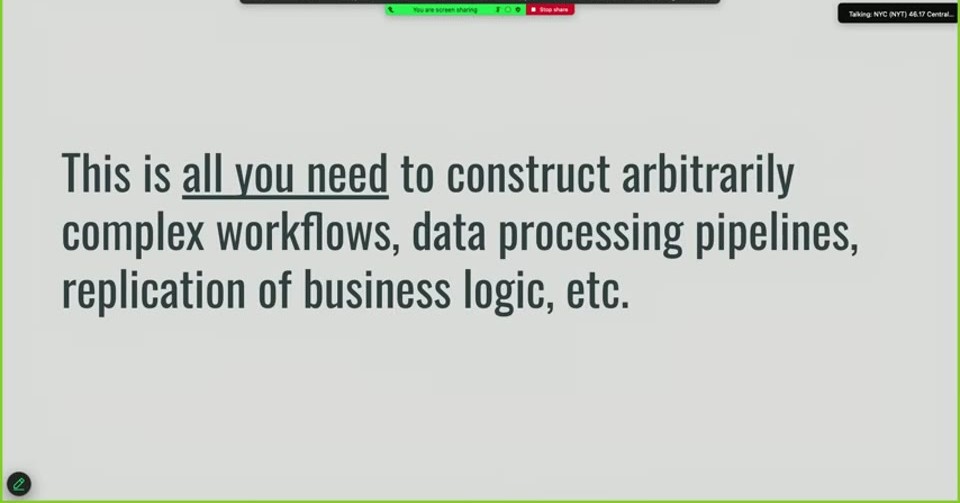
This is all you need to construct arbitrarily complex workflows, data processing pipelines, replication of business logic, etc.
- Recreated text/layout view: open HTML recreation
- AI slide classifier:
content_slideconfidence0.98 - Text source: advanced OCR
rapidocr-live/bright-screen/contrastreconciled by agent. - OCR decision: ready — Table-like slide with multiple rows and short labels; OCR should handle it better than manual transcription in this pass.
Slide text:
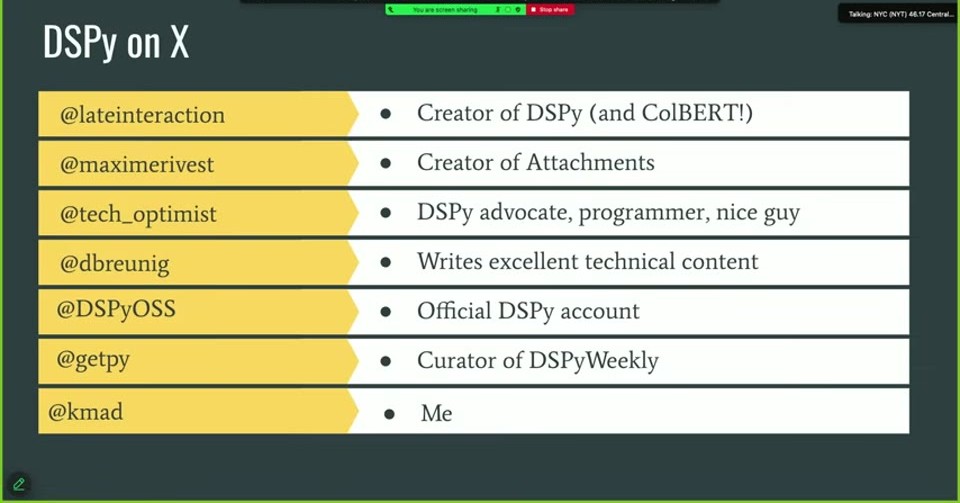
DSPy on X
@lateinteraction Creator of DSPy (and ColBERT!)
@maximerivest Creator of Attachments
@tech_optimist DSPy advocate, programmer, nice guy
@dbreunig Writes excellent technical content
@DSPyOSS Official DSPy account
@getpy Curator of DSPyWeekly
@kmad Me
Classification audit: raw/sources/slide-ai-classification/dense/-cKUW6n8hBU/audit.json